
Semantic content density is the share of a passage's sentences that state a checkable fact.
Raise it by turning claims into facts. Low density is easy to feel. Picture a page that says "our experienced team delivers quality care." The reader learns nothing they can check.
I found no published target density, so I treat the count as an editing test and never as a score.
What does semantic content density measure?
Semantic content density measures how many checkable facts a passage holds for the words it spends. A fact names one thing, one property of it and the value of that property.
Dejan AI, a practitioner site, describes information density as the ratio of substance to words. That fits the idea here, though I count sentences, not words.
Google's helpful content guidance asks whether content gives substantial value compared with other pages in search results. Google documentation says this as a question for the writer. It is not a density formula, and I have found no Google page that defines semantic content density.
How do you count semantic content density on a page?
You count semantic content density by marking each sentence as a fact or a claim and dividing facts by sentences. It is quick work. One page is enough.
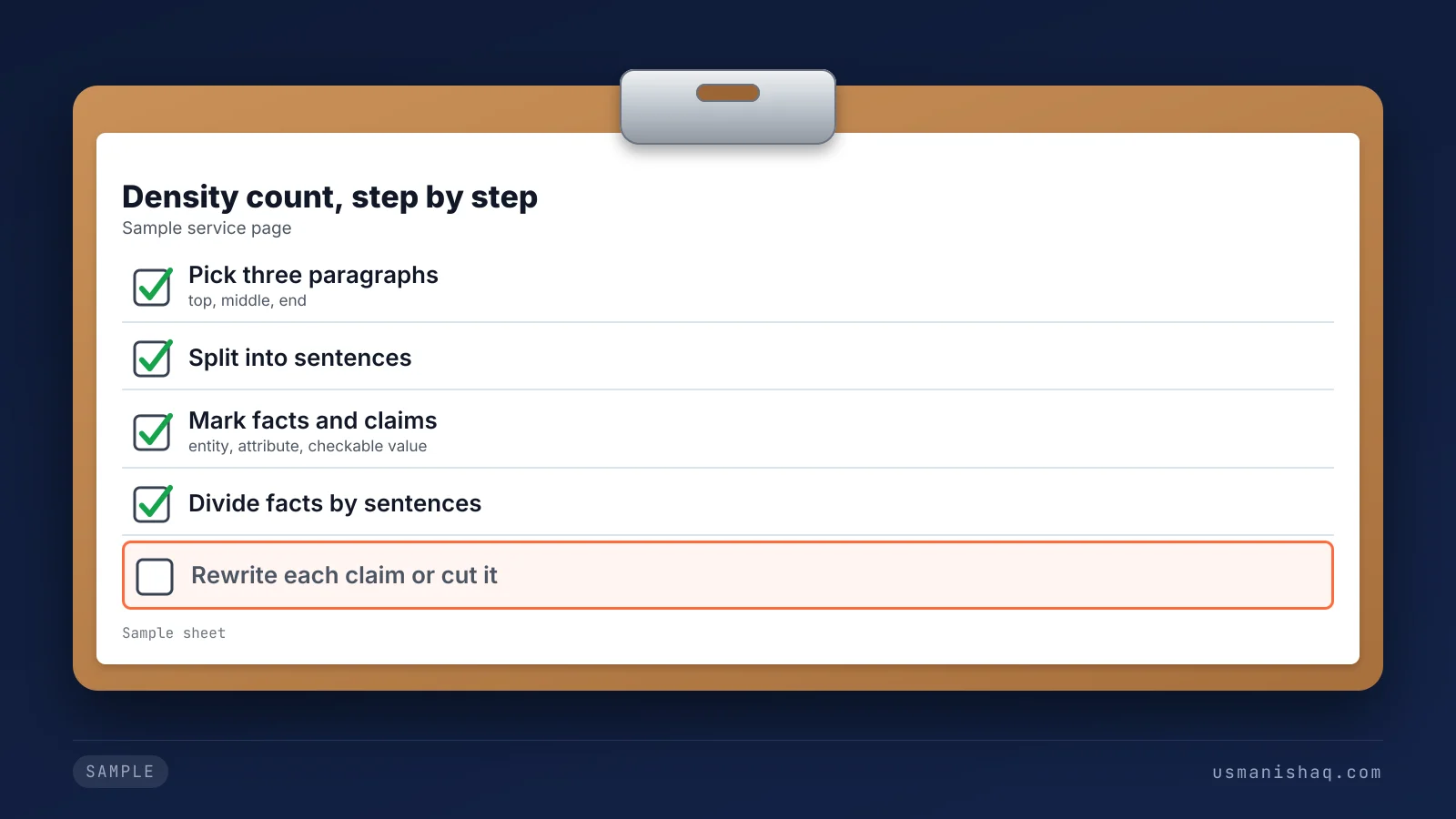
- Pick three paragraphs from one service page, one near the top, one in the middle and one near the end.
- Split each paragraph into sentences.
- Mark a sentence as a fact when it names the entity, one attribute and a value a customer could check.
- Mark every other sentence as a claim.
- Divide the facts by the sentences.
- Rewrite each claim into a fact, or cut it.
Step six often turns up a hole in the business's records. If the owner cannot say how fast a technician arrives, the page cannot state it either.
What does the count look like on a dental clinic paragraph?
On a dental clinic paragraph, the count moves from 0 of 4 sentences to 4 of 4 without adding many words. The sample below uses a made-up practice in Riverton.
The first version reads like most clinic pages. It states a mood and no values.
| Sentence in the first version | Verdict |
|---|---|
| Our friendly Riverton team offers gentle, modern implant dentistry. | Claim |
| We pride ourselves on exceptional care for every patient. | Claim |
| Implants are a great long-term solution. | Claim |
| Call today to learn more. | Claim |
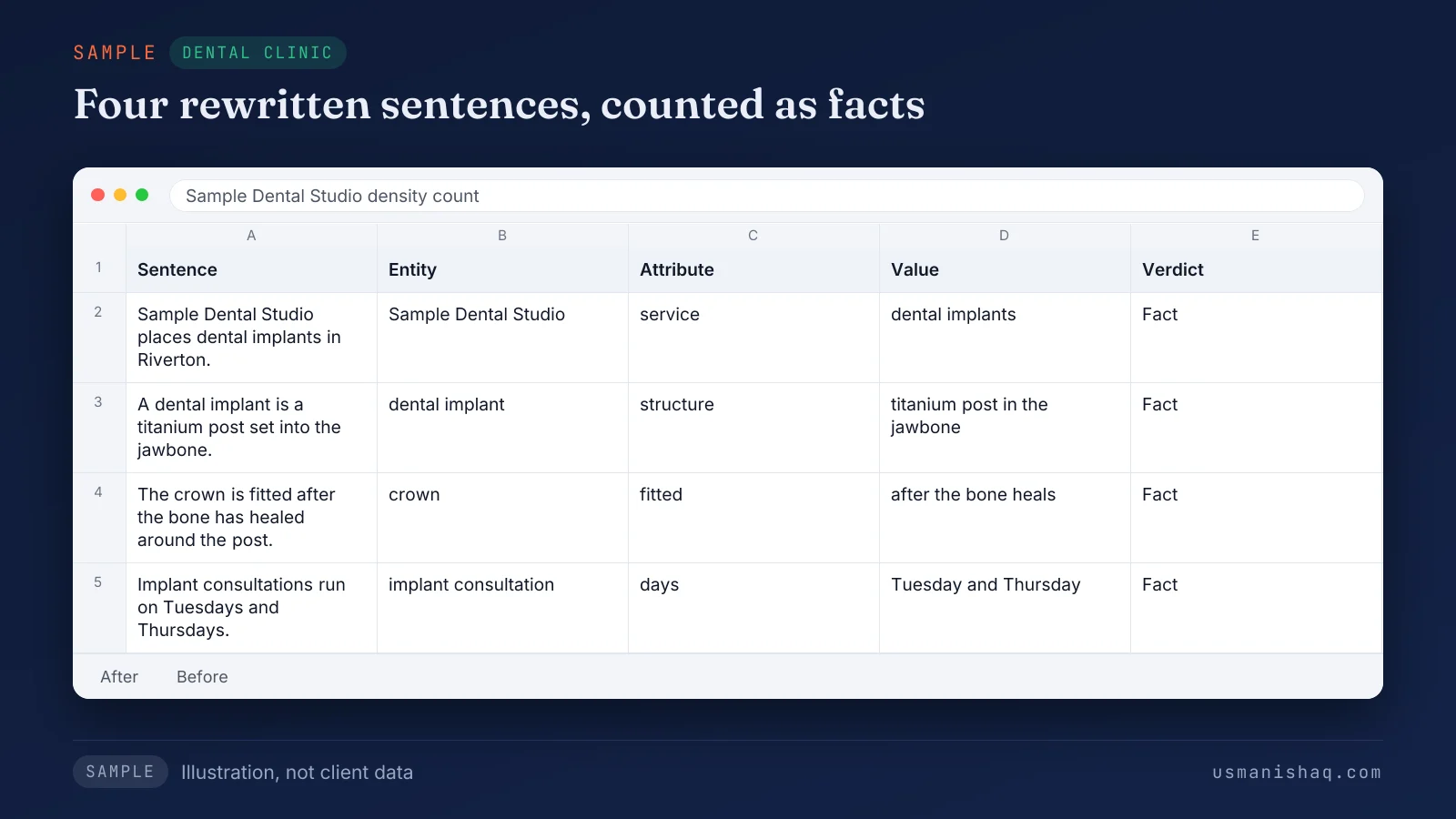
The first version scores 0 of 4. The rewrite below scores 4 of 4, and the sheet shows each fact split into entity, attribute and value.
| Rewritten sentence | Entity | Attribute | Value | Verdict |
|---|---|---|---|---|
| Sample Dental Studio places dental implants in Riverton. | Sample Dental Studio | service | dental implants | Fact |
| A dental implant is a titanium post set into the jawbone. | dental implant | structure | titanium post in the jawbone | Fact |
| The crown is fitted after the bone has healed around the post. | crown | fitted | after the bone heals | Fact |
| Implant consultations run on Tuesdays and Thursdays. | implant consultation | days | Tuesday and Thursday | Fact |
The rewrite added about ten words. The practice's days are sample values, and a real page takes them from the clinic's own diary.
Five habits that lower semantic content density
Five habits lower semantic content density, and each one swaps a value for a feeling.
- Praise words such as "quality" and "trusted" give an opinion and no value.
- A sentence that restates its heading in new words adds no fact.
- Vague time words such as "fast" hide a value. "Same day for calls before noon" is a value.
- A closing line such as "contact us today" tells the customer what to do, and nothing about the service.
- A list of adjectives in front of a noun, such as "friendly, gentle, modern", spends words on no value.
I find the second habit harder to spot than the rest, because a restated heading reads smoothly. Cover the heading with your hand and ask what the sentence taught you.
Limits of semantic content density
Semantic content density has four limits, and ignoring them produces pages nobody reads.
- A sentence that holds three facts is harder to read once. I keep to one fact per sentence, two at most, and under 20 words.
- A true fact nobody asks about is padding with a number in it. The year the clinic building went up rarely answers a customer's question.
- A stale fact is worse than a claim. Wrong opening hours cost a customer a trip.
- Density does not replace the search words. The title and the first sentence still name the entity in the words customers type.
I have no test that links a higher fact count to a ranking change, so I would not promise one. A page that answers more questions in fewer words serves the customer better, and that is reason enough to edit.
Semantic content density compared with keyword density and word count
Semantic content density differs from keyword density and word count because it counts facts, not repeats of a phrase or total words.
| Measure | What it counts | How a page fails it |
|---|---|---|
| Keyword density | how often a phrase appears | the phrase repeats and no fact follows |
| Word count | total words on the page | padding fills the length |
| Semantic content density | checkable facts per sentence | sentences state claims |
Writing every page of a site to this count is the work inside semantic content production briefs and pages.
More questions about semantic content density
Owners ask three more things: how dense a page should be, whether AI can write one and where a count fits.
How dense should a service page be?
A service page should state a fact in most of its sentences, and you set the exact share. I know of no tested figure, so I judge each page by whether its claims have run out. Service page writing steps cover what each section of the page states.
Can an AI tool write a dense page?
An AI tool can write a dense page from facts you supply, and it may pad when given only a topic. The facts have to come from the business, so a person supplies them first. Letting AI write trade business pages goes through what to hand the tool.
Where does a density count fit in a content audit?
A density count is one check inside a semantic content audit, run first on pages that already get impressions. Content audit checks and their order show where it sits among the others.
Semantic content density in short
Semantic content density is the share of sentences that state a checkable fact. You count it by marking claims and facts, then you rewrite each claim into a fact or cut it. No target number exists, so I use the count to edit a page and not to score it.