
Service oriented keywords are the search phrases that name a job a service business does, such as drain cleaning.
Software people use the same words for service-oriented architecture. This page covers the phrases a customer types to find a plumber, a dental clinic or a law office.
Those phrases come in four kinds. You sort them by what the searcher wants, test each one against the results page, and give it one owner. A phrase that fails the test becomes a guide instead of a service page.
What are service oriented keywords?
Service oriented keywords are search phrases that name a job a business does, such as "drain cleaning" or "teeth whitening".
A customer types one when the next step is hiring someone. The phrase holds a job, and it often holds a town. "Why is my drain slow" asks for knowledge. "Drain cleaning" asks for a provider.
You can tell the two apart by looking at the best result. If it is a page where someone can book, call or request a quote, the phrase is a service keyword. Anything else, such as an explainer, points to a guide.
The four kinds of service oriented keywords
Service oriented keywords come in four kinds, and each kind adds one thing to the service name.
The table uses a sample dental clinic in Springfield.
| Kind | Sample phrase | What the customer wants | Usual home |
|---|---|---|---|
| Service name | teeth whitening | To see whether the clinic does it | Service page |
| Service plus town | teeth whitening springfield | A clinic close enough to visit | Service page, or a town page |
| Service plus problem | chipped front tooth repair | A fix for something that happened | Section, or its own page when results differ |
| Service plus price or speed | emergency dentist springfield | An answer today, or a cost | Own page when results show separate pages |
A site that stops at the first kind misses the customer who adds a town or a hurry. That customer is often closer to calling.
The order matters when you write. Start with the service name, because every other kind hangs from it. Add the town next, then the problem, then the price or speed word. A page that opens with "emergency" before it says what the clinic does confuses the customer and the owner.
How do you build the list from what the business sells?
You build the list from the jobs the business invoices, then add the words customers use for each job.
I start from invoices because a keyword for a job you do not sell brings the wrong calls. The steps run in this order.
- Pull a year of invoices or booked jobs and list each job by name.
- Write the customer's word next to your word. A clinic says "dental prophylaxis" and the customer types "teeth cleaning".
- Add the town for each job the staff do in person.
- Add one problem phrase per job, taken from questions customers ask on the phone.
- Search each phrase once and run the hire test below.
Google documentation says to think about the words a user might search for to find a piece of content. It adds that people who know a topic may use different words than newcomers. Step 2 is that advice made into a column.
Once the list is checked, a Semantic SEO Architecture keyword-to-page map gives every phrase its owning page before any page is written.
Which phrases should you leave off the list?
Leave off phrases for jobs you do not sell and towns you do not serve.
A job you refer to another firm stays off. Towns outside your drive time stay off. So does a phrase whose results are all national brands, which a small clinic is unlikely to outrank.
A short sheet where every phrase has an owner is easier to keep up than a long one nobody reads. A phrase that survives the cuts goes through the hire test.
What is the hire test for a service keyword?
The hire test counts how many of the top ten results sell the job the phrase names.
This is my own rule of thumb, and the thresholds are mine, not Google's. Search the phrase in a private window. Count the pages among the first ten that sell the job.
- Six or more sell the job. The phrase is a service keyword and earns a service page or a section of one.
- Three to five sell it. The results are mixed. Build the service page and answer the question in a section on it.
- Two or fewer sell it. The phrase is a guide keyword. Write a guide and link it to the service page.
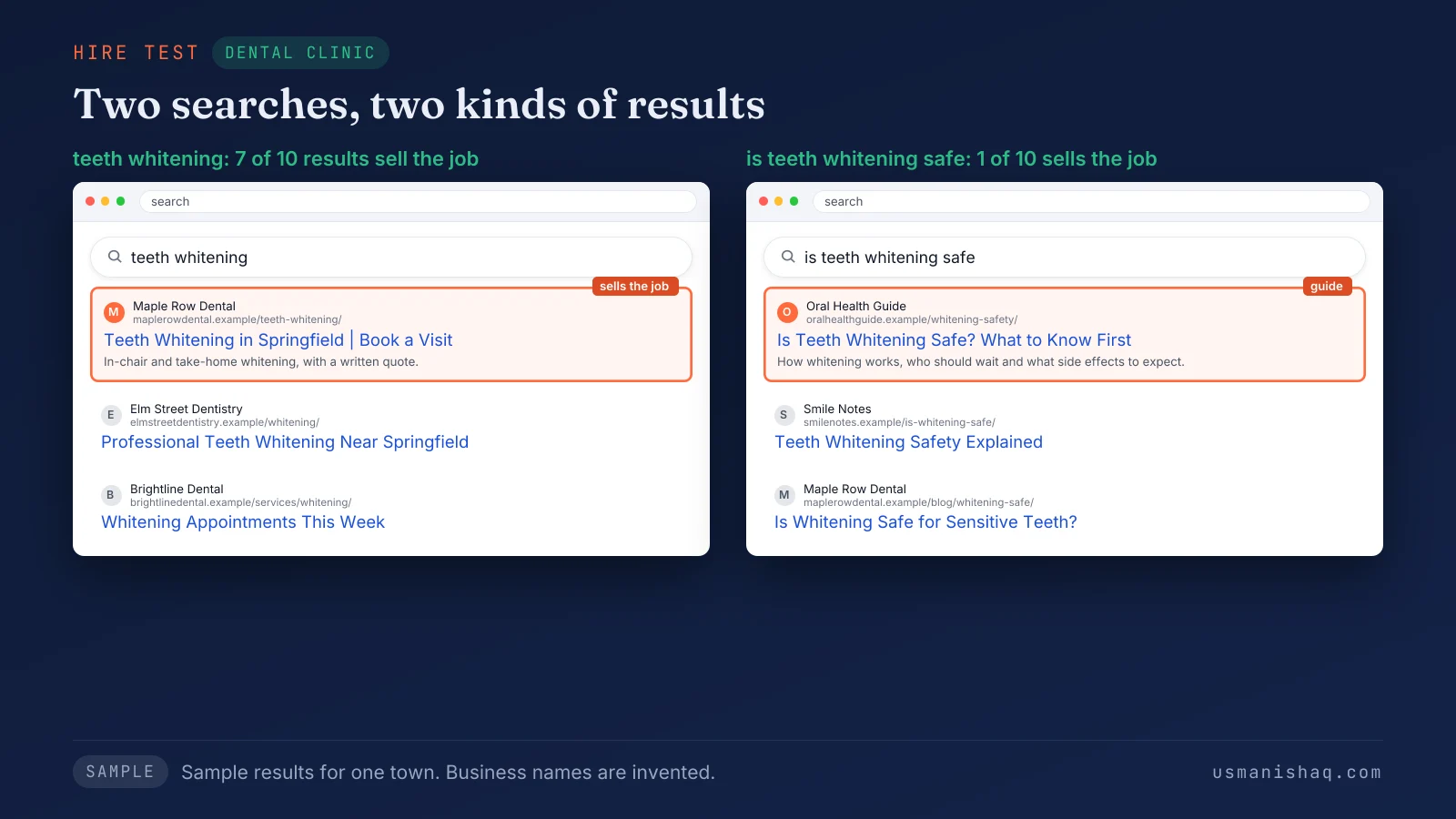
In the sample, "teeth whitening" shows seven selling pages in ten. "Is teeth whitening safe" shows one clinic page among nine guides.
Worked example for a dental clinic in Springfield
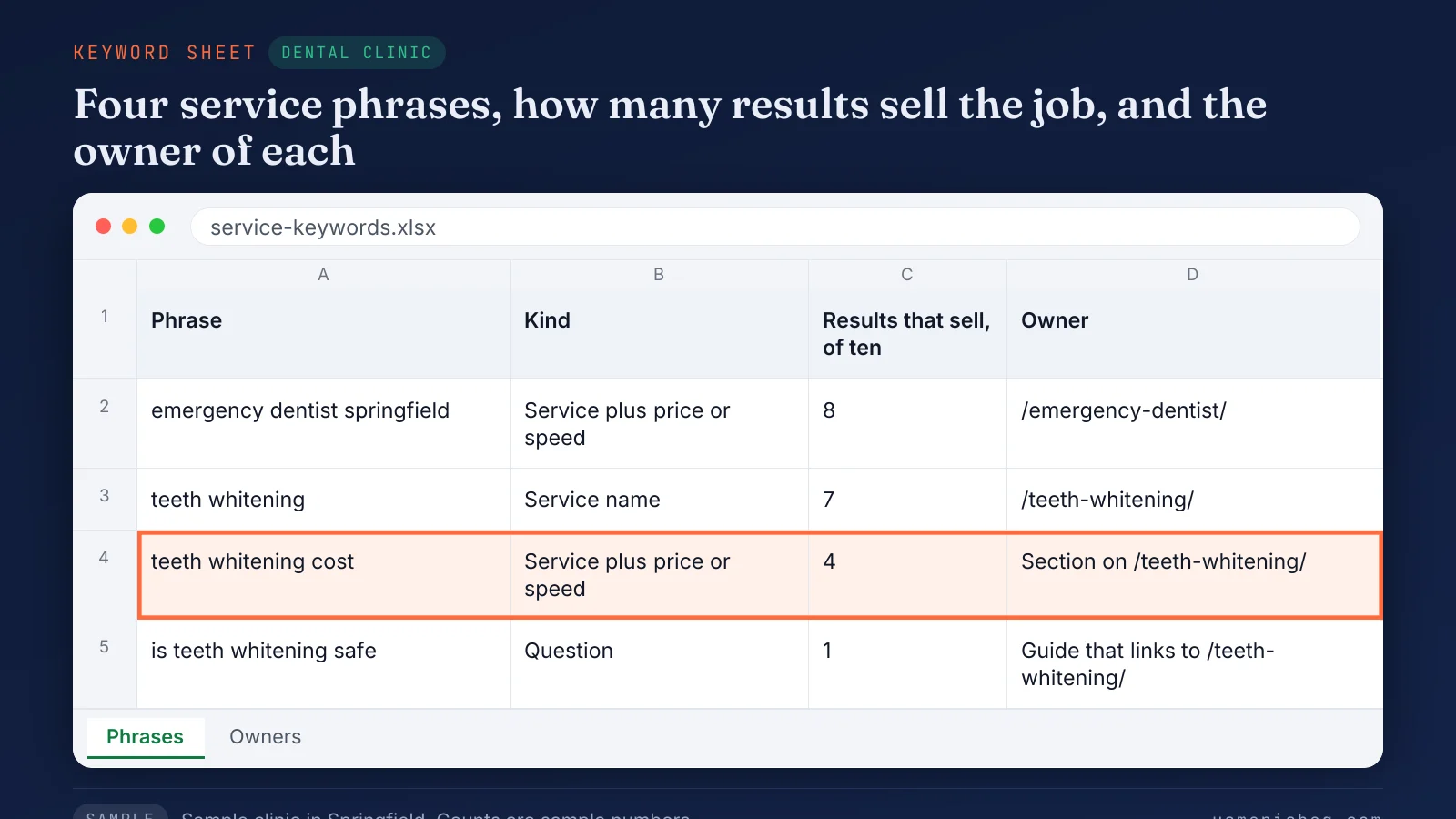
A worked example for a dental clinic in Springfield sorts four phrases into two service pages, one section and one guide.
Every figure below is a sample. Springfield and the clinic are made up. The counts are the kind you would write down after your own searches.
| Phrase | Kind | Results that sell, of ten | Owner |
|---|---|---|---|
| emergency dentist springfield | Service plus price or speed | 8 | /emergency-dentist/ |
| teeth whitening | Service name | 7 | /teeth-whitening/ |
| teeth whitening cost | Service plus price or speed | 4 | Section on /teeth-whitening/ |
| is teeth whitening safe | Question | 1 | Guide that links to /teeth-whitening/ |
The cost phrase shows four selling pages, so the results are mixed and the phrase needs a closer look. The clinic answers it in a section and does not build a third service page. With one selling page in ten, the safety question gets a guide.
The sheet also sets the writing order. "Emergency dentist springfield" has the most selling results, so its page goes first. Customers who type it are ready to book today, and a slow week on that page costs the clinic real appointments. The whitening page follows, and the guide comes last.
Write the owner in the last column before anyone writes a word of the page. That one column decides what gets built. Two phrases with one owner are one keyword, and the sheet counts them once. One phrase with two owners means two pages will fight for it, and you pick one.
What the counts on the sheet do not tell you
The counts on the sheet come from one search, so they cannot show what every customer sees.
Results change by town, by device and by day. A count of seven from your office on a Tuesday may read five for a customer across town. Treat the number as a band. Seven, eight and six all say "service page". Four and five say "mixed", and that is where you should look at the results again before you decide.
Re-run the count a month after the page goes live. Then open Search Console and read the queries that showed the page. Customers often use a word you never listed, such as "whitening trays" for the take-home kit. Add that word to the sheet and to the page, and leave the owner column alone.
Questions owners ask once the list is sorted
Once the list is sorted, owners ask about towns, local keywords and how many phrases one page carries.
Should every service keyword carry the town?
No, a service keyword needs the town only when the job happens in person and the results show local pages.
A clinic in Springfield needs the town. Software sold to people everywhere does not. The pages on what decides which town a website ranks in show how a town changes the results.
Is a service keyword the same as a local keyword?
No, a service keyword holds a job and a local keyword holds a place, and one phrase can hold both.
"Plumber springfield" is both. "Drain cleaning" is a service keyword with no place in it. Each service keyword still needs a page that says what the job includes. That work is covered in writing the service page for each keyword.
How many service keywords does one page need?
One page needs one main phrase and the close variants whose results look the same.
Two phrases that return the same ten pages are one keyword. Phrases that return different pages need different owners. The test for whether a phrase gets its own page works through the cases that sit in between.
Service oriented keywords in short
Service oriented keywords are the phrases a customer types when the next step is hiring someone.
Build the list from invoices, run the hire test on every phrase and write one owner next to each. A phrase with two or fewer selling results gets a guide, not a service page.