
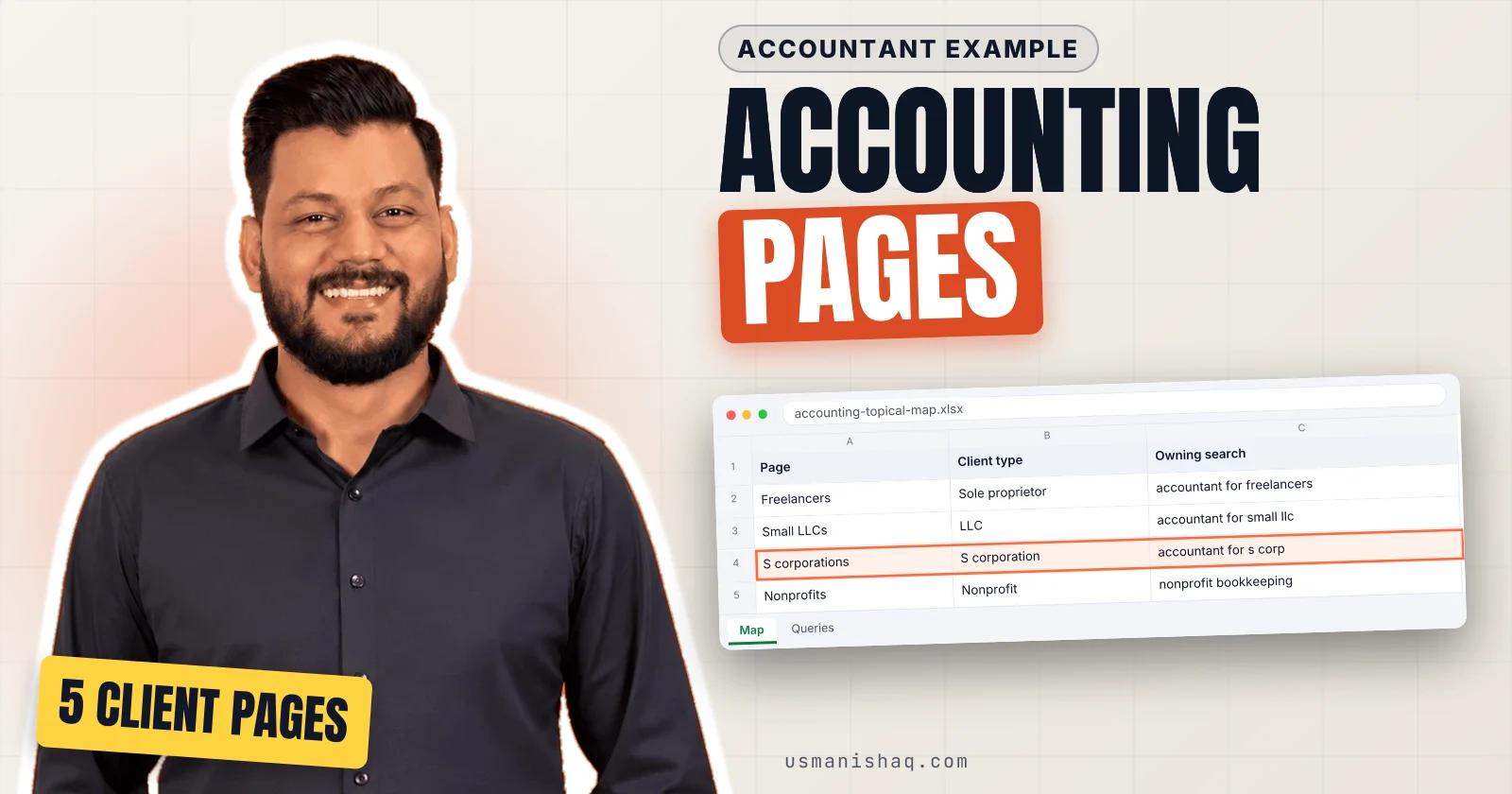
A topical map for an accounting firm website lists service, client type, date and software pages, each with one owning search.
An accounting firm sells to many kinds of client. A freelancer, a restaurant and a nonprofit all need books, and each searches in different words. The firm that answers each one on its own page gets found by all three.
A page describes what your firm does. It never tells a reader what to file or when to pay, because a licensed preparer owns that advice for each client.
How an accounting map differs from a services list
An accounting map differs from a services list because entity type, tax date and software each produce their own pages.
Most firm sites list five services on one page and call it done. Bookkeeping, payroll, tax preparation and advisory share a single address, so none of them owns a search.
Entity types tell you who walks in. Tax dates tell you when they search. Software tells you what they already use.
You decide which attributes your firm actually sells to. A firm that serves only freelancers skips the nonprofit rows. Dropping rows matters as much as adding them. Cut the ones you cannot serve.
Entity type pages
An accounting firm needs a page for each client entity type, because each type has its own work and searches.
A sole proprietor, an LLC, an S corporation, a partnership and a nonprofit do not need the same work. Each type searches for "accountant for" followed by its own name. The page answers that search and nothing else.
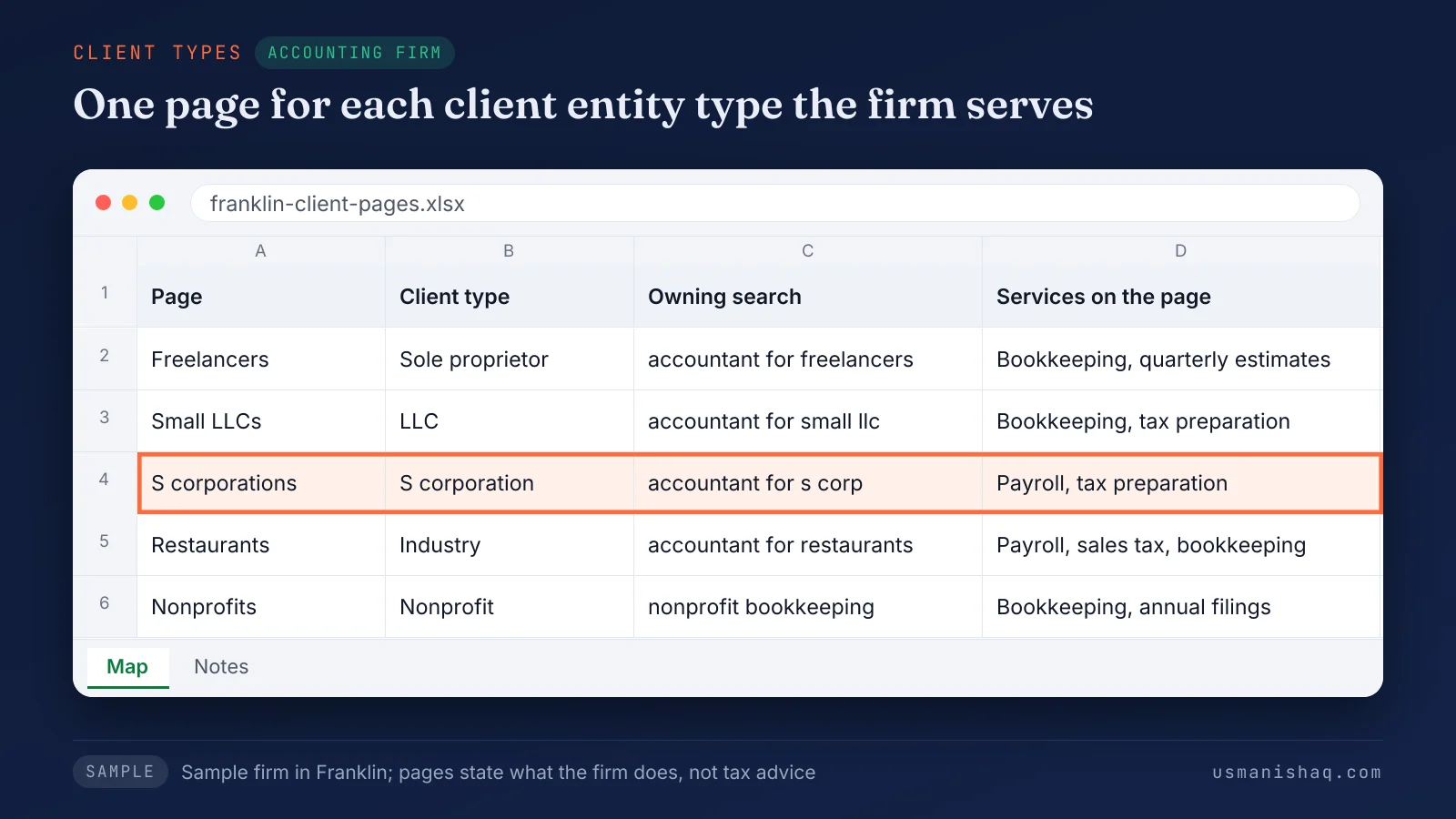
The three-person Franklin firm below is a stand-in, and the rows stand for a real firm's pages.
| Page | Client type | Owning search | Services on the page |
|---|---|---|---|
| Freelancers | Sole proprietor | accountant for freelancers | Bookkeeping, quarterly estimates |
| Small LLCs | LLC | accountant for small llc | Bookkeeping, tax preparation |
| S corporations | S corporation | accountant for s corp | Payroll, tax preparation |
| Restaurants | Industry | accountant for restaurants | Payroll, sales tax, bookkeeping |
| Nonprofits | Nonprofit | nonprofit bookkeeping | Bookkeeping, annual filings |
Industry rows sit beside entity rows. A restaurant owner does not search by entity type, but by trade, such as "accountant for restaurants". Serve a trade well and it gets a page.
Each row names the services the firm sells to that client, not what the client should choose. The advice itself waits for the engagement.
Software pages
An accounting firm writes a software page only for a product the firm supports and can show it uses.
Clients ask whether you work in their tool, and they type "quickbooks accountant" or "xero bookkeeper". If your firm has certified staff or daily use, a page for that product answers the search.
Your page states what the firm does in that software. It might set up the chart of accounts, reconcile accounts monthly or clean up a messy file. It does not teach the product, since the vendor already does.
Do not list a product you only touched once. Give the staff member's name and the work she performs. That detail separates your page from a software vendor's directory listing.
If the firm migrates clients between products, give that its own page. The search "switch from quickbooks to xero" has a different buyer from the one who already chose.
Dated pages that expire every year
A dated accounting page states a deadline taken from the tax authority's own page, and the firm reviews it each season.
Customers search for "estimated tax dates" or "extension deadline". A page that answers can bring consultations, but a stale date does harm.
I plan around one habit. Every dated page carries three cells in the sheet, which hold the page, the tax authority's source page and the review date. Nobody types a date from memory.
Pick one reviewer for the sheet. After each filing season, that person walks the list and updates each page. A date that did not change still gets a fresh stamp.
Keep dated pages few. A firm needs a handful, such as the filing deadline, the extension and the quarterly dates. Everything else is a service page that holds no date.
A dated page, worked through
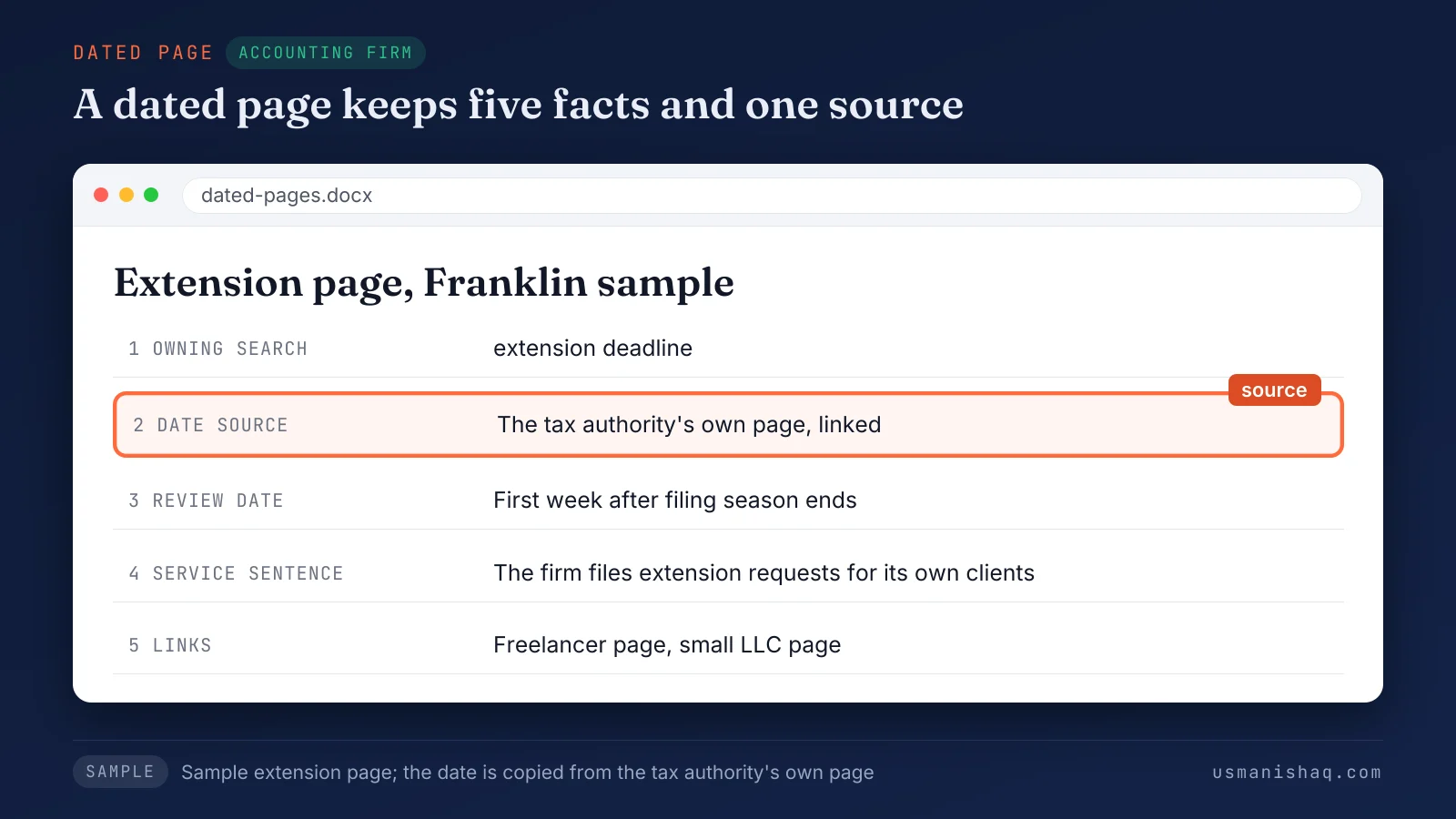
A dated page for an extension deadline holds five facts, and the date itself comes from one named tax authority page.
Take the extension page at the Franklin sample firm. The owning search is the extension deadline. The date cell links to the tax authority's own page, and the review date reads the first week after filing season ends.
The fourth fact is the service sentence, which says the firm files extension requests for clients it already prepares returns for. The fifth is the link list, pointing to the freelancer page and the small LLC page.
Now ask what happens in the next season. Next season the reviewer opens the sheet, follows the source link and compares. Either the date holds or it changes. Either way the stamp moves forward, and nobody rewrites the page.
Service pages for bookkeeping, payroll, tax preparation and advisory
Each job with its own buyer, its own price shape and its own next step earns a service page.
Bookkeeping repeats monthly and tax preparation peaks once a year, while payroll runs on a cycle with a cutoff. Advisory is a project with a start and a finish.
The split looks like the one in a trade business. Buyers of monthly books want reliability, and buyers of a tax return want a deadline met. Pages differ because people do.
Put the entity pages and the service pages in the same map, and link every pair of related pages in both directions. A freelancer page points to bookkeeping and quarterly work. The bookkeeping page points back to the client types it serves.
What the pages leave out
An accounting page describes what the firm does and leaves tax and legal advice to the licensed preparer and the engagement letter.
Write "we prepare returns for S corporations" and not "an S corporation should elect this". The second sentence is advice, and a web page cannot know the facts of the person reading it.
State the licences your staff hold in the words their boards use. Say who signs a return. Give the process, such as intake, review and delivery. Skip promises about refunds or savings.
The Semantic SEO Architecture review calendar and page set fixes the pages, their order and the review dates up front.
Tax news, the firm name and fees
Three questions follow the dated pages, and they are about tax news, the firm name and fees.
Should the firm blog about tax law changes?
Write about a change only when the firm can name the source and the date. Send the reader to the preparer for what it means for them.
Another licensed practice faces the same limit. The way the law firm map handles bar rules is in the topical map for a law firm website.
Does the firm name need its own page?
Yes, the firm name belongs on one about page that states the firm, its people and its credentials the same way everywhere.
The reasoning is in source context and the central entity.
Should an accounting website show fees?
It can show how fees are set, such as monthly or per return, and say the engagement letter holds the amounts.
Carry the same summary on the home page, and plan both together as in planning pages before you write them.
The accounting map, briefly
An accounting map gives each entity type, service, dated deadline and supported software one page. Each page keeps to what the firm does.
Build the entity and service pages first. Add software pages for the products you support, and keep a short list of dated pages with a named reviewer. Leave advice to the licensed people who give it to a client.