
A topical map for an electrician website is the plan of its pages, with one page owning each search. Semantic SEO plans the map so search engines understand which page answers each electrical search.
An electrician website needs a service page for each electrical service, town pages that earn a place, inspection pages and question pages. An electrician website is structured as service folders and town folders, with price, question and town pages linked to their service page.
An electrician's topical map is measured in calls, quote requests and booked jobs per page, with impressions and clicks as the cause. An electrician website's topical map breaks under five faults, and each fault gives one search two owning pages or none.
What is a topical map for an electrician website?
A topical map for an electrician website is the plan of its pages, with one page owning each search.
An electrician needs pages for the jobs customers call about, the towns the business covers and the questions customers type first.
Service pages name the job, such as "panel upgrade", "EV charger installation" or "house rewire". Town pages name one service in one town. Inspection pages name the check or certificate the customer wants.
Electricians ask "what pages does my website need" and rarely say "topical map". Semantic SEO keeps the map as rows: one row per page, with its owning search, intent and URL.
What pages does an electrician website need?
An electrician website needs a service page for each electrical service, town pages that earn a place, inspection pages and question pages.
Service pages come first below, then the charger and panel pair, inspection pages, question pages and commercial pages. Trust pages complete the site: the home page, the about page with licence and insurance, the reviews page and the contact page.
Trust pages own no search beyond the business name, so the table leaves them out. The table below is a sample topical map for Brightline Electric (Sample), an electrical contractor working in Riverton and Oakdale.
| Page | Section | Owning search | Intent | URL |
|---|---|---|---|---|
| Emergency electrician | Core | emergency electrician | Transactional | /emergency-electrician/ |
| House rewiring | Core | house rewire | Commercial | /rewiring/ |
| Rewire cost | Core | how much does it cost to rewire a house | Commercial | /rewiring/cost/ |
| Panel upgrade | Core | panel upgrade | Commercial | /panel-upgrade/ |
| EV charger installation | Core | ev charger installation | Commercial | /ev-charger-installation/ |
| Lighting installation | Core | lighting installation | Transactional | /lighting/ |
| Electrical inspection | Core | electrical inspection | Transactional | /electrical-inspection/ |
| Electrical repair | Core | electrical repair | Transactional | /electrical-repair/ |
| EV charger installation in Riverton | Core | ev charger installation riverton | Transactional | /riverton/ev-charger-installation/ |
| Panel upgrade in Oakdale | Core | panel upgrade oakdale | Transactional | /oakdale/panel-upgrade/ |
| Panel upgrade for an EV charger | Outer | do i need a panel upgrade for an ev charger | Informational | /panel-upgrade/ev-charger/ |
| 100 amp vs 200 amp panel | Outer | 100 amp vs 200 amp panel | Informational | /panel-upgrade/100-vs-200-amp/ |
| Breaker keeps tripping | Outer | why does my breaker keep tripping | Informational | /electrical-repair/breaker-tripping/ |
| Signs a house needs rewiring | Outer | signs your house needs rewiring | Informational | /rewiring/signs/ |
No two rows share an owning search. The rows are a worked example, not a client result. Each owning search should be confirmed in Google Search Console or search suggestions before the page is built.
Informational intent is to learn, commercial intent is to compare or price, and transactional intent is to book. Semantic SEO treats each row as one page decision, and the core rows start with service pages.
Which electrical services earn their own service page?
An electrical service earns its own page when its job, price, proof or next step differs from the other services.
The electrical services that most electrician maps hold as service pages are listed below:
- Emergency electrician: power loss, burning smells and sparking outlets that need a visit today.
- House rewiring: old wiring replaced through a whole home, priced by quote.
- Panel upgrade: the main panel replaced or enlarged, called a consumer unit in the UK.
- EV charger installation: a home car charger and the circuit that feeds it.
- Lighting installation: indoor, outdoor and recessed lighting work.
- Electrical inspection: the safety check or certificate customers book by name.
- Electrical repair: fault finding, dead outlets and tripping breakers.
Vendor keyword guides for electricians focus on panels, chargers and emergency work. Rewiring still earns a core page, because the job is large and customers search for it by name. Semantic SEO names each service page by the job customers type.
Charger and panel work need a closer look, since the two jobs meet so often.
Why do EV charger installation and panel upgrades get separate pages?
EV charger installation and panel upgrades get separate pages because the customer, the search and the next step differ.
An EV charger customer wants a home charger fitted. A panel upgrade customer has an old panel, tripping breakers or new loads to add.
The charger job often raises the panel question, so each page links to the other.
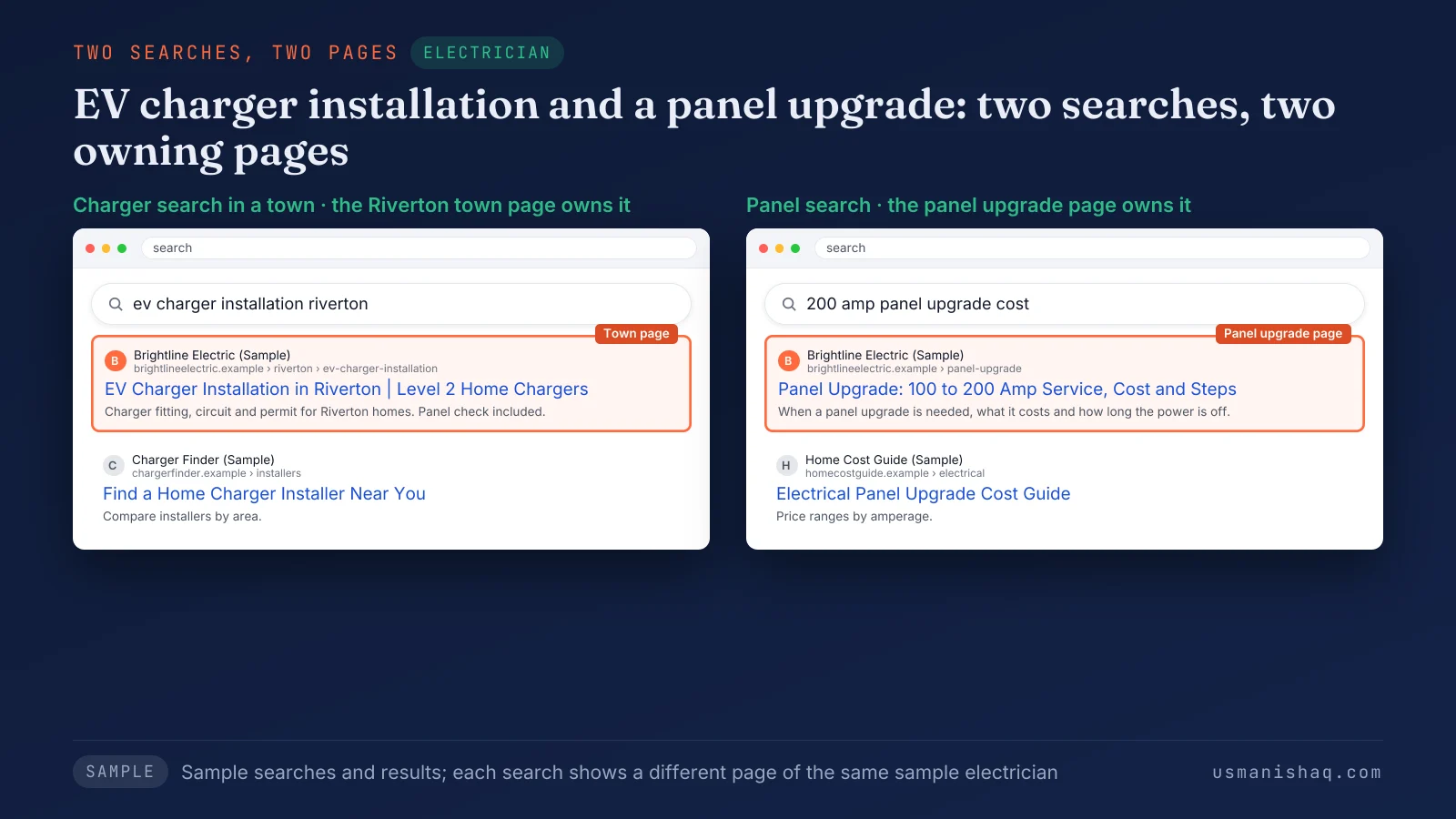
The sample search "ev charger installation riverton" returns the Riverton EV charger page. The sample search "200 amp panel upgrade cost" returns the panel upgrade page of the same electrician.
One merged page answers both searches and owns neither. Semantic SEO splits a service family where the searches split. Inspection work follows a rule of its own.
Which inspection and certificate pages does an electrician website need?
An electrician website needs one inspection page for each inspection or certificate its customers search for by name.
Semantic SEO names each inspection page in the customer's words. Landlords in England search for the Electrical Installation Condition Report that GOV.UK guidance names, known as an EICR.
GOV.UK guidance of 1 November 2025 requires landlords in England to have rented-home installations inspected and tested at least every 5 years. The five-year rule gives an English electrician a recurring EICR search, and an EICR page owns it.
Planning Portal guidance for England names a new or replacement consumer unit as notifiable electrical work. The Planning Portal adds a new circuit and work around a bath or shower to the notifiable list for England.
An electrician registered with a competent person scheme self-certifies that work in England, according to the Planning Portal. The about page then names the scheme.
Electricians in the United States work under a state or city licence, and many jobs need a permit and an inspection. American inspection pages follow the customer's reason, such as a home sale.
Customer questions about electrical work follow a separate page test.
Which electrical questions earn a question page?
An electrical question earns a question page when its search differs from the search the service page owns.
A search earns a page when customers type it, it names a different thing, and Google shows different results for it. The search "100 amp vs 200 amp panel" earns a question page, and so does "why does my breaker keep tripping".
The search "how long is the power off during a panel upgrade" stays a section of the panel upgrade page.
Does a cost question earn a question page? A cost question earns a price page in the core section, such as rewire cost.
Semantic SEO keeps question pages in the outer section, each one feeding an electrician's service page.
Commercial work adds a different set of rows.
Does a residential electrician need commercial electrical pages?
No, a residential electrician does not need commercial electrical pages until the business takes commercial work.
Which commercial rows does the map add? Commercial lighting, workplace EV charging and emergency lighting testing each take a service page in a commercial folder. Residential and commercial jobs mixed on one page bring calls the electrician turns away.
Semantic SEO then gives each kept row its place in the site structure.
How is an electrician website structured?
An electrician website is structured as service folders and town folders, with price, question and town pages linked to their service page.
The publication order comes once the folders are set. The five parts of an electrician website structure are listed below:
- Service folder: one folder for each service page, such as /panel-upgrade/.
- Pages inside the folder: the price page /rewiring/cost/ and question pages such as /panel-upgrade/100-vs-200-amp/.
- Town folder: one page for one service in one town, such as /riverton/ev-charger-installation/.
- Links: each question and town page links to its service page, and each service page links back. The home page links to every service page and the emergency page.
- Schema: Electrician, Service and areaServed markup on each town page, stating only what the page shows.
Some vendor guides build a page for every service in every city. The map above keeps the service page as the hub instead.
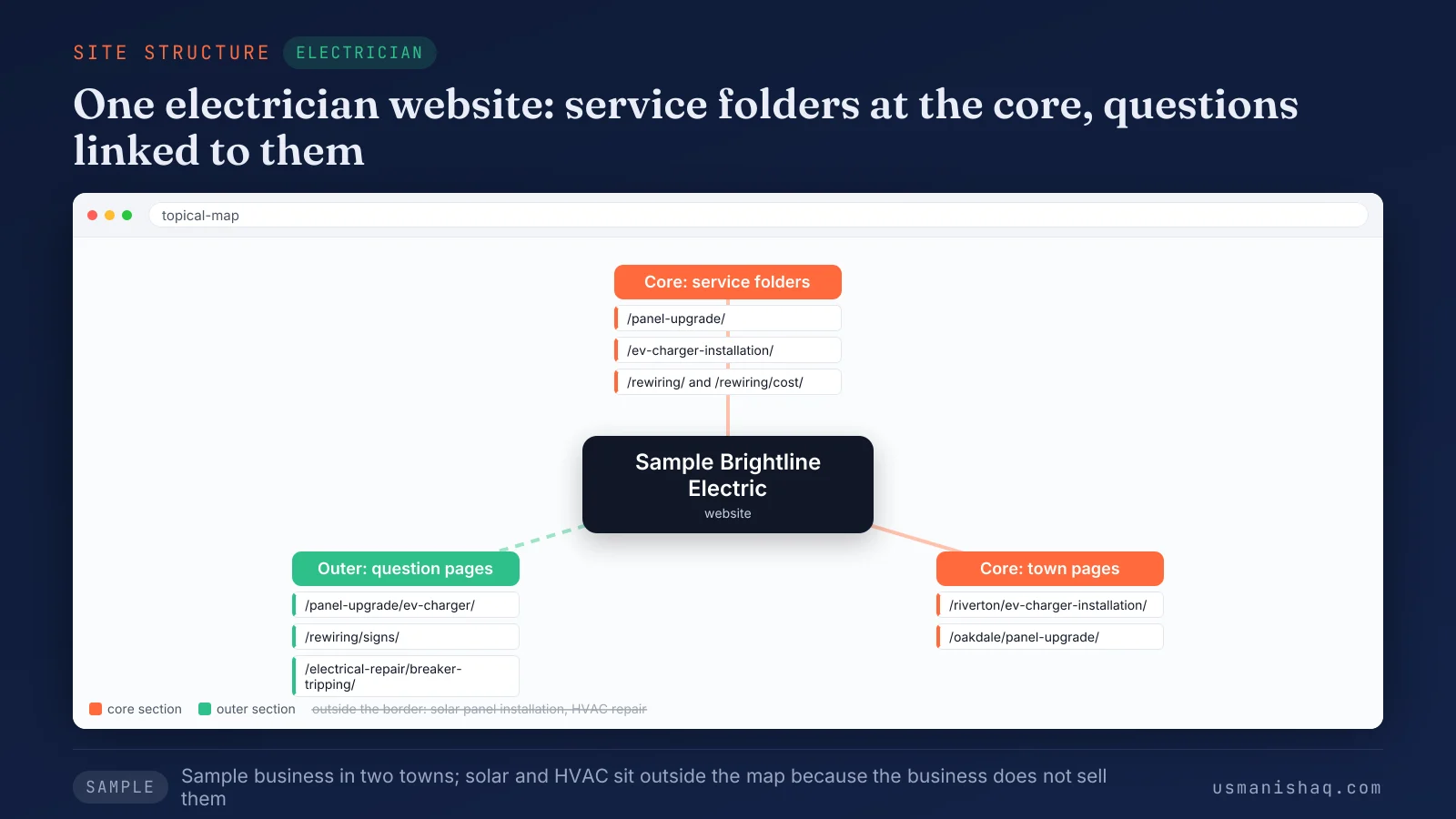
The figure groups the sample site into three service folders, two town pages and three question pages. Solar panel installation and HVAC repair sit outside the map.
Semantic SEO fixes the folders before the pages, and the pages then go live in a set order.
In what order should an electrician publish its pages?
An electrician should publish the emergency page first, then service pages, price pages, inspection pages, town pages and question pages.
The steps to publish the pages of an electrician website are listed below:
- Publish the emergency electrician page, where the intent to call is highest.
- Publish the service pages, jobs the business wants more of first.
- Add price pages where customers search the cost.
- Add inspection pages for certificates customers book by name.
- Add town pages that earn a place, then question pages.
My advice is to publish the panel upgrade page before the EV charger page, because charger jobs often raise the panel question.
Semantic SEO architecture writes this order into the map. The fixed-scope project that plans the map, its order and a 12-month roadmap is the Semantic SEO Architecture for an electrician website. Each published page is then judged by the calls it brings.
How is an electrician's topical map measured?
An electrician's topical map is measured in calls, quote requests and booked jobs per page, with impressions and clicks as the cause.
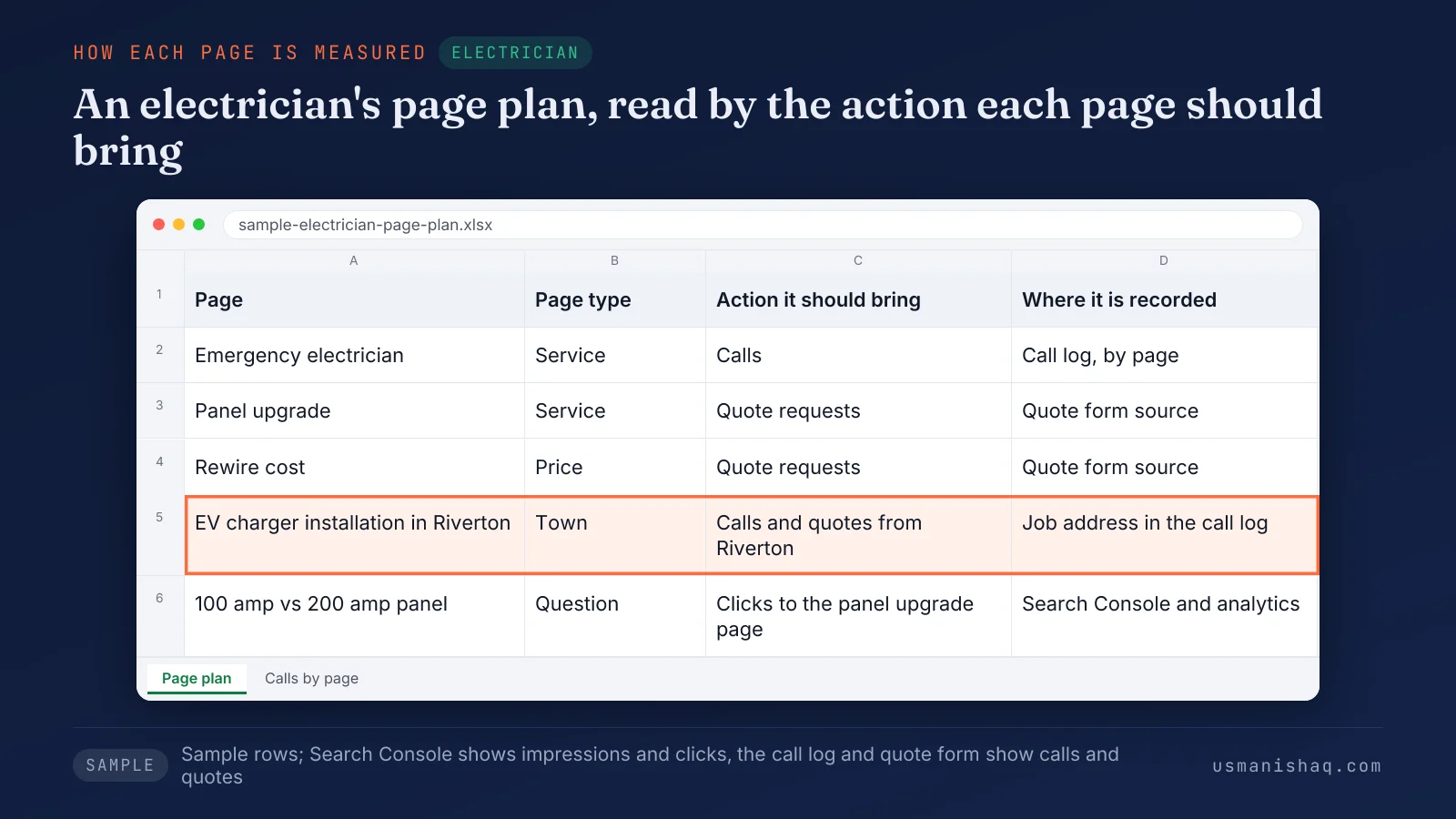
The sample sheet lists five pages and the action each should bring. The emergency page brings calls, and the panel upgrade and rewire cost pages bring quote requests.
The Riverton charger page brings calls and quotes from Riverton. The 100 amp vs 200 amp page brings clicks to the panel upgrade page.
Google Search Console shows the impressions and clicks of each page, and the call log shows the calls. Semantic SEO reads each row of the map against the calls the page brings. The map holds its worth only while the website avoids five faults.
Which faults break the topical map of an electrician website?
An electrician website's topical map breaks under five faults, and each fault gives one search two owning pages or none.
The five faults that break the topical map of an electrician website are listed below:
- One Services page: every electrical job shares one page, so no job owns a search. The fix is a page per job.
- Every service in every town: each town page repeats one text with the town name swapped. Google's spam policies for Google web search treat such near-identical place pages as doorway pages. The fix is town pages that earn a place.
- Competing posts: a blog post on EV charger costs answers the search the EV charger page owns.
- Unsold services: solar pages on the site of an electrician who does not install solar bring calls the business turns away.
- Mixed residential and commercial pages: one page for homes and offices answers neither customer well. The fix is a commercial folder.
Semantic SEO checks the map for all five faults before a page is written. The checks run again for each new town or country.
How does an electrician's topical map change for a new town or country?
An electrician's topical map keeps the same five columns in a new town or a new country, and only the rows change.
The town comes first below, then the country. Any topical map takes five steps: describe the business, collect searches, decide owners, set page types and order the pages.
A separate guide sets out the steps to plan a topical map for a business website. The topical map as a planning method comes from the framework of Koray Tuğberk Gübür.
A plumbing company's map keeps drain, water heater and repiping rows, as the topical map planned for a plumbing company website shows. The structure, page order and measure in calls hold for any trade or service business. All three are set out in the semantic SEO plan for trade and service businesses.
Semantic SEO keeps the columns fixed, so maps of different towns and countries compare row by row.
How does the map change when an electrician adds a town?
A new town enters an electrician's topical map as a row, and becomes a town page only when it earns one.
A town earns its own page when it has its own searches, its own jobs and its own proof. Electricians call such pages city pages or service area pages.
A town that fails the test stays a mention on the areas-served page. Semantic SEO applies the same town test to every electrician's map.
New town pages take time to bring their first calls. A separate guide covers the time a new town page takes to bring calls.
How does the map change for an electrician in another country?
An electrician's map in another country keeps the columns and renames the service, inspection and licence rows.
UK customers search "consumer unit replacement" where American customers search "panel upgrade". Semantic SEO keeps the row and renames the page after the local search.
The rented-home rule comes from the GOV.UK electrical safety standards guidance, so an English map keeps its EICR page. An American map names the state or city licence instead, with permit and inspection pages where customers search them.
Electricians in other countries name each row after the certificate their customers ask for. The about page in every country names the licence or scheme, the insurance and the reviews.
Questions electricians ask about website pages
Electricians ask three further questions about website pages: the need for a website, the page count and blog posts.
Do electricians need a website?
Yes, an electrician needs a website to hold a page for each service, town, inspection and question that customers search. The website and the profile should match, and a separate guide lists the fields a Google Business Profile and website share.
How many pages does an electrician website need?
An electrician website needs one page for every search that passes the page test, so no fixed number applies. The sample map above holds 14 pages: seven service, one price, two town and four question pages.
Does an electrician website need a blog?
Yes, an electrician website needs question pages, and a blog is one place to hold them. Each post answers one customer question and links to its service page, such as a breaker post linking to electrical repair.
The topical map for an electrician website and the next step
The next step for an electrician website is a topical map that gives each service, town, inspection and question one owning page. The electrician builds the pages in the map's order, emergency page first. Semantic SEO plans that order so search engines understand which page answers each job, town, certificate and question.