
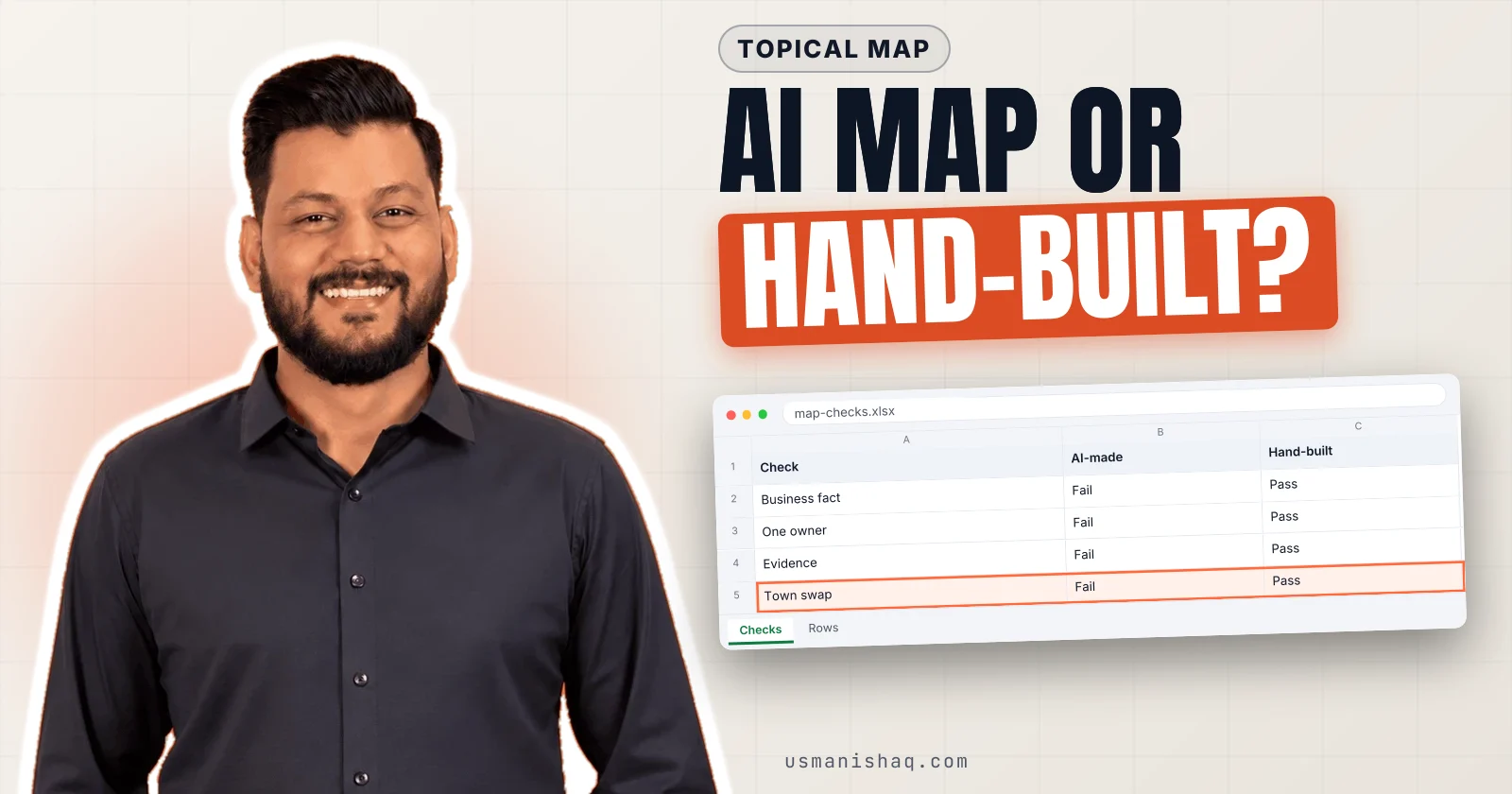
Five checks on the sheet tell a hand-built topical map from an AI-made one: facts, owners, evidence, sections and a town swap.
Who typed the rows is the wrong question. A person can use AI to draft a list, and a person can copy a competitor's list by hand. What matters is whether someone decided each row against the business.
The five checks take about ten minutes and need no tool. You run them on whatever map you were handed.
Take a dental clinic in Springfield as the sample. I made the clinic up, and the scores are mine.
What is the difference between an AI topical map and a hand-built one?
An AI topical map is a model's list from a seed, and in a hand-built map a person decided each row.
A model clusters well. The AppSumo listing for Topical Map AI says its tool clusters up to 1,200 keywords into a topical map. That is a fast way to get a long list.
A list is not yet a plan. Ahrefs's manual method adds steps after the list. Its third step asks if each topic has business value, and its sixth maps existing pages and new URLs to each topic. Those steps are decisions, and a person makes them for one business.
A Semantic SEO Architecture topical map records those decisions for a single company.
Five checks that tell the two apart
Five checks tell a hand-built topical map from an AI-made one: business facts, owners, evidence, decisions and the town swap.
Run them in order. A map of thirty rows needs a minute or two for each.
| Check | What you do | A hand-built map shows | An AI-made map shows |
|---|---|---|---|
| 1 Business fact | Pick five rows and find each service or town in your price list or job records | Every row traces to something you sell or serve | Rows for work you do not offer |
| 2 One owner | Sort the owning-search column and look for repeats | Each search has one page | "Best", "top" and "guide" rows for the same search |
| 3 Evidence | Ask where each row came from | A date and a source, such as Search Console or the live results page | Volume numbers with no date, or none |
| 4 Decisions | Count the rows marked as a section or a sentence | Some rows are marked as sections | Every row is a page |
| 5 Town swap | Replace your town and name with a competitor's | The map stops fitting | The map reads the same |
Check four carries a rule of mine. When fewer than one row in five is marked as a section, I treat the sheet as a raw list. That is my own habit, with no source behind it.
Swap the town last. It is the quickest check. A map made for your business breaks when you do that, and a generic one does not.
The five checks on a sample dental clinic map
On a sample dental clinic map, an AI-made sheet fails all five checks, and a fixed hand-built sheet passes them.
Say the clinic offers checkups, dental implants, emergency visits and teeth whitening, and no braces. The AI-made sheet has six rows, and every row is a page.
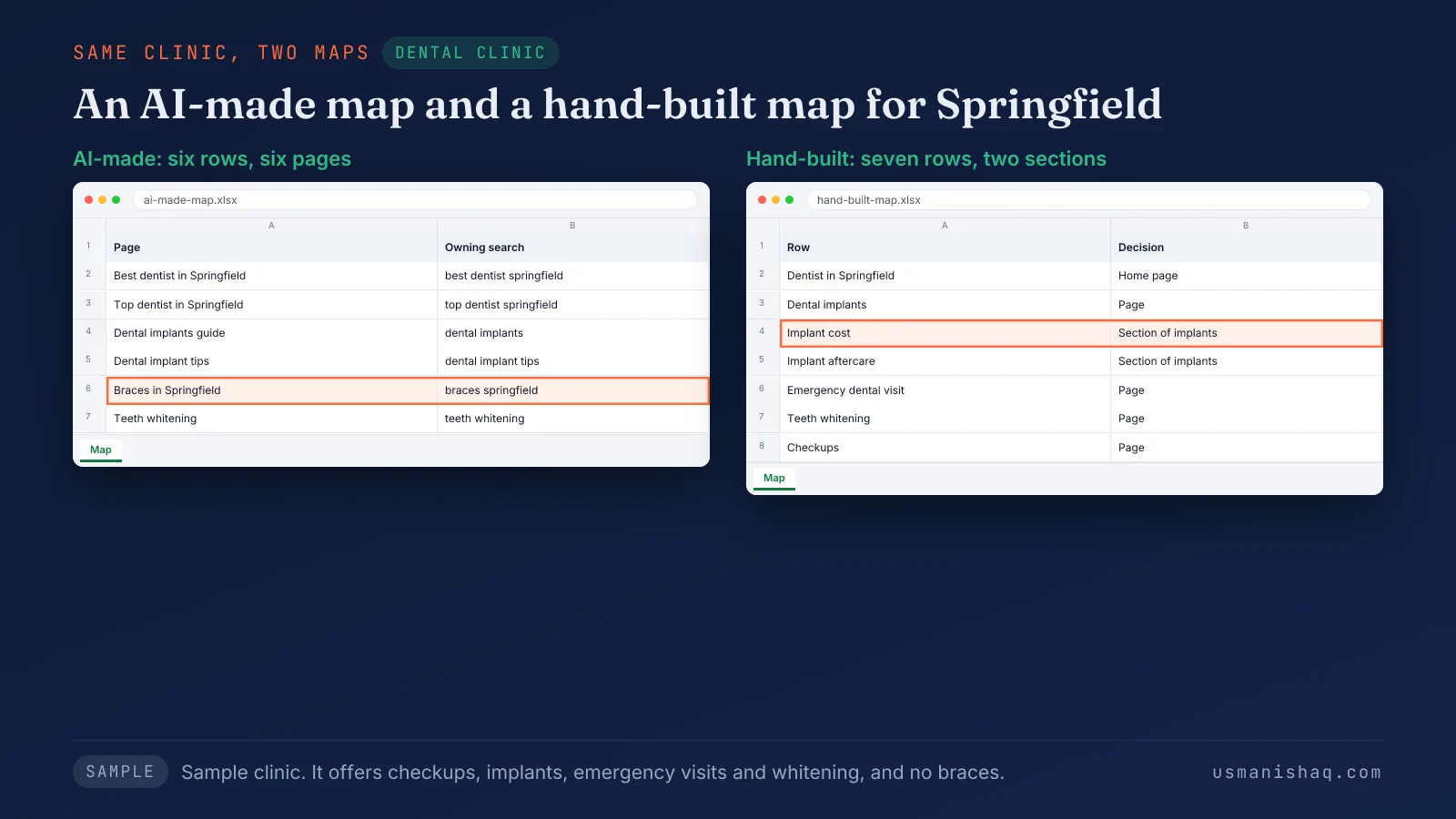
Four rows are about dentists and implants: "Best dentist in Springfield", "Top dentist in Springfield", "Dental implants guide" and "Dental implant tips". The other two are "Braces in Springfield" and "Teeth whitening".
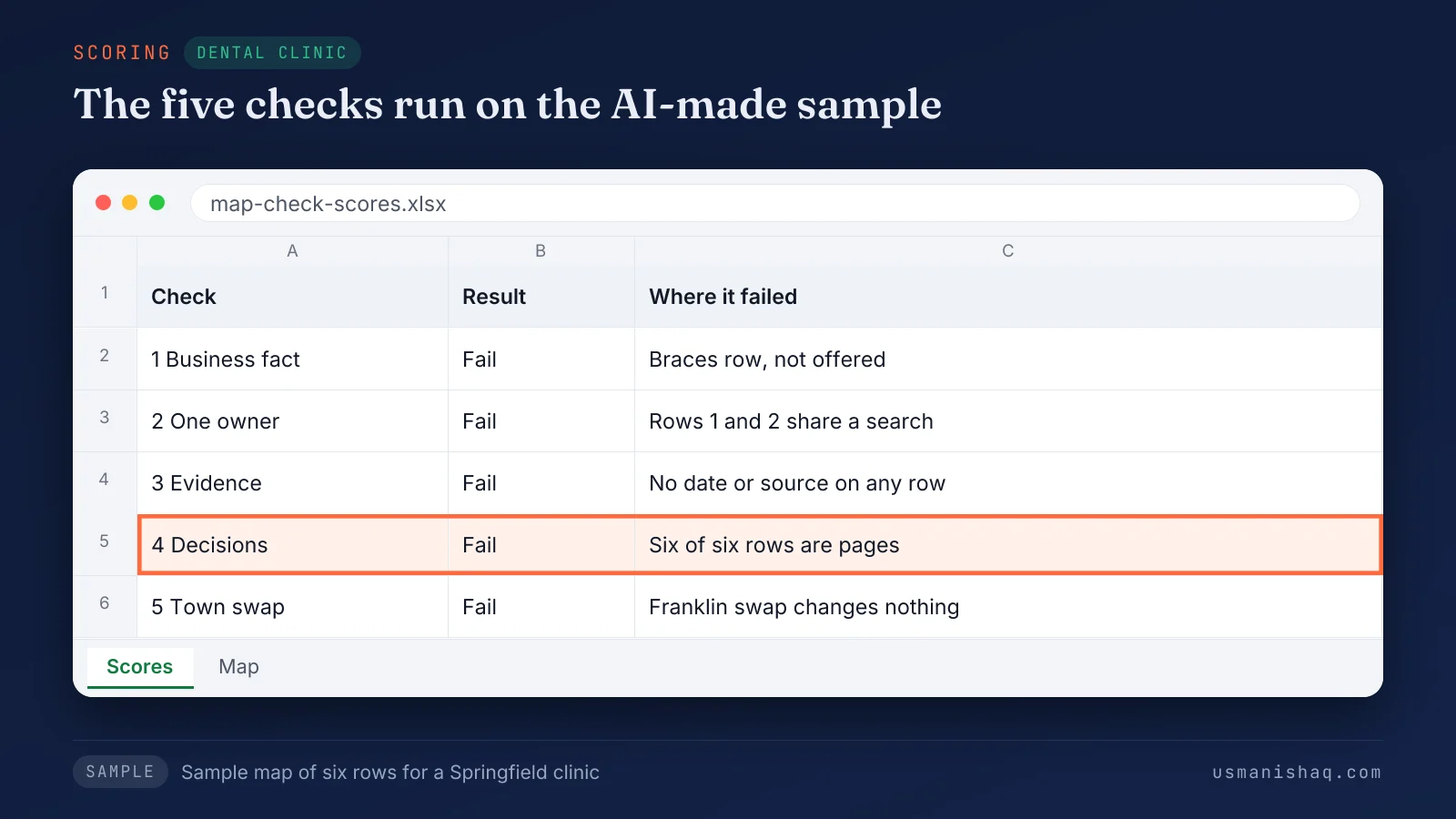
Check one fails on the braces row, because the clinic does not offer braces. Two pairs of rows break check two. Rows one and two chase one search, and the implant guide and tips rows overlap. No row carries a date or a source, so check three fails too.
All six rows are pages. That fails check four. Swapping Springfield for Franklin changes nothing on the sheet, so check five fails.
A hand-built version has seven rows. Its home page owns the dentist search for Springfield. Dental implants, emergency dental visit, teeth whitening and checkups each get a page. Implant cost and implant aftercare become sections of the implants page. Two of seven rows are sections, which clears my one-in-five line.
Where AI helps a hand-built map
AI helps a hand-built map at the drafting stage, and the person keeps every decision the five checks test.
Google's guidance on generative AI says it can be particularly useful for researching a topic and adding structure to original content. That page also warns that generating many pages without adding value for users may violate the scaled content abuse policy.
I read that as a rule about pages, and a map is a planning sheet. Risk starts when a map of two hundred rows turns into two hundred pages nobody decided on. The checks catch that before a page is written.
AI also helps with the first pass on questions to answer, and it is quick at grouping a long search list. It cannot know which services you sell or which town pays. Those facts come from you.
Questions to ask before you pay for a map
Ask four questions before you pay for a topical map, and expect a document in reply to each.
- Which rows did you merge or drop, and why? A hand-built map has a log of cuts.
- Where did each row come from, and on what date?
- Which of my services or towns did you leave out on purpose?
- What would change in this map after a core update?
Answers that arrive as sheets and dates are a good sign. Answers that arrive as promises are not. The same four questions work on a freelancer, an agency or a tool.
More questions owners ask about AI topical maps
You can fix an AI map yourself, and Google's policy targets pages, not planning sheets.
Can I fix an AI topical map myself?
Yes, you can fix an AI topical map yourself with the five checks, by deleting rows, merging rows and adding sources.
Start with check one, such as a braces row for a clinic that offers none. Rows for work you do not offer are the cheapest to delete. Then merge repeats and mark detail rows as sections. What semantic SEO tools output covers what the software returns. The planning steps are in how a topical map is built for a business website.
Is a hand-built topical map worth the extra cost?
A hand-built topical map is worth the cost when the business sells several services or serves several towns.
A clinic with one service in one town needs only a short list. An AI draft that you check may be enough. A company with six services and four towns has many repeats to settle. A person with the sales and job records settles them.
Will Google penalize an AI topical map?
Google's published policy covers pages, and a map is a planning sheet that no visitor sees.
Google's scaled content abuse policy applies to pages made at scale without value for users. A map that you check and prune leads to fewer pages, not more. Whether the pages themselves should come from AI is a separate decision, covered in whether AI should write the pages themselves.
AI topical map or hand-built map in short
A hand-built topical map shows decisions on the sheet, and an AI-made one shows a long list.
Run the five checks on any map you receive. Delete what fails, merge what repeats and keep the dated sources.