
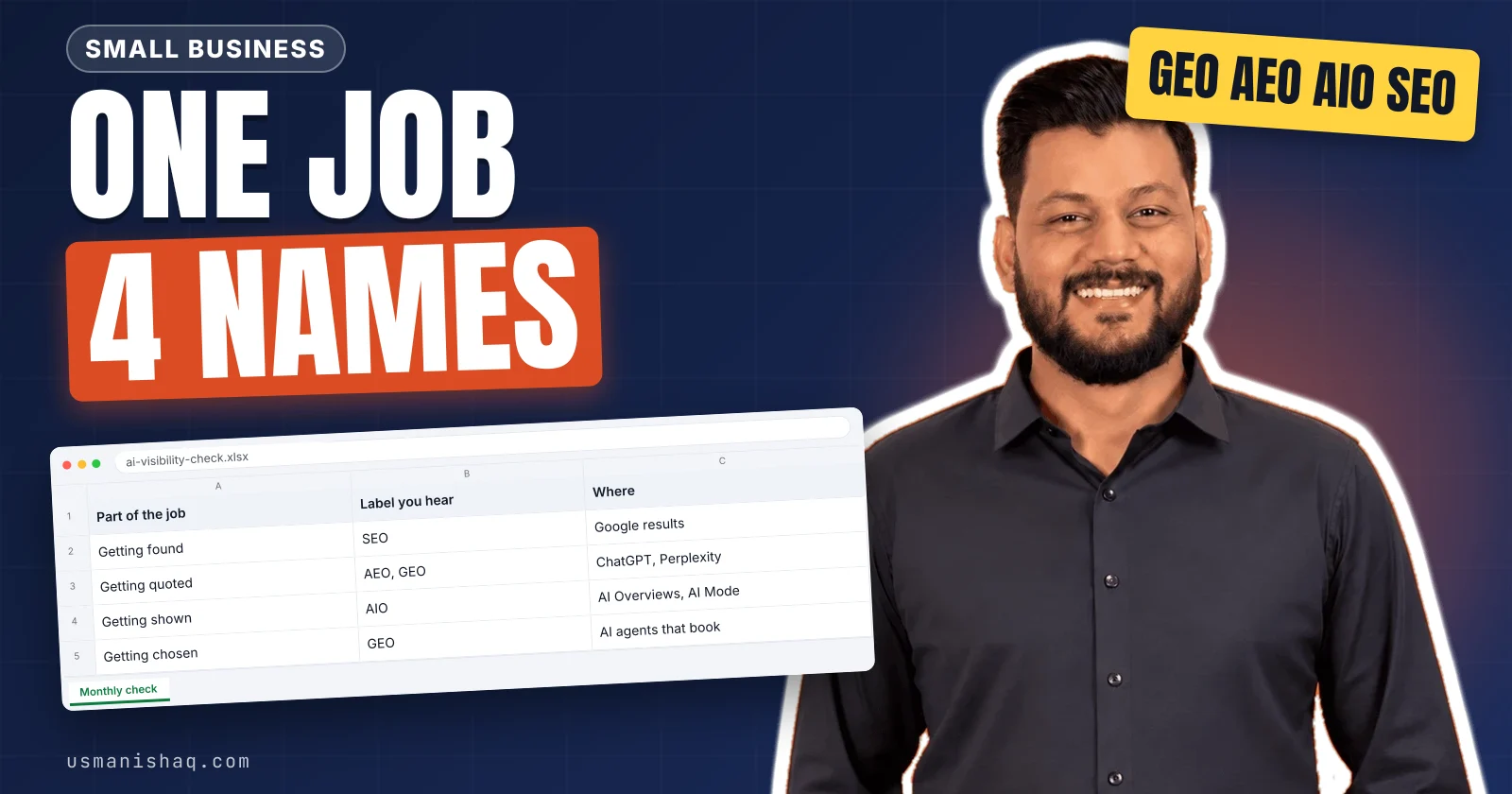
GEO, AEO and AIO are names for parts of SEO, and for a small business they describe one job. The job has four parts: getting a business found, quoted, shown and chosen by search engines and AI systems.
A small business does not need GEO as a separate program, because Google treats work for its AI features as SEO. Each part asks the website for something different, and GEO work starts with getting found, then shown, then quoted, then chosen.
Semantic SEO sits under all four parts, because semantic SEO decides which pages exist and what each page means.
What do GEO, AEO, AIO and SEO mean for a small business?
GEO, AEO, AIO and SEO mean four parts of one job: getting a business found, quoted, shown and chosen.
SEO stands for search engine optimization. AEO stands for answer engine optimization, and GEO stands for generative engine optimization. AIO stands for AI optimization, though some sellers use AIO for Google AI Overviews.
Sellers attach these labels loosely. GEO, AEO and LLM SEO name the same work in most guides: getting quoted inside AI answers. Older AEO guides also cover featured snippets and voice assistants.
The four parts of the job, with the labels sellers attach to each, are compared below:
| Part of the job | Where it happens | Labels you will hear | What the business checks |
|---|---|---|---|
| Getting found | Google results and the map pack | SEO | Rankings, clicks and calls |
| Getting quoted | ChatGPT, Perplexity, Gemini and other assistants | AEO, GEO, LLM SEO | Whether answers name the business |
| Getting shown | Google AI Overviews and AI Mode | AIO, GEO | AI impressions in Google Search Console |
| Getting chosen | AI agents that book, call or buy | GEO, agent optimization | Bookings and calls from AI surfaces |
The parts stay fixed while the labels move between sellers. Asking which part a label covers gets a clearer answer than asking what the label means.
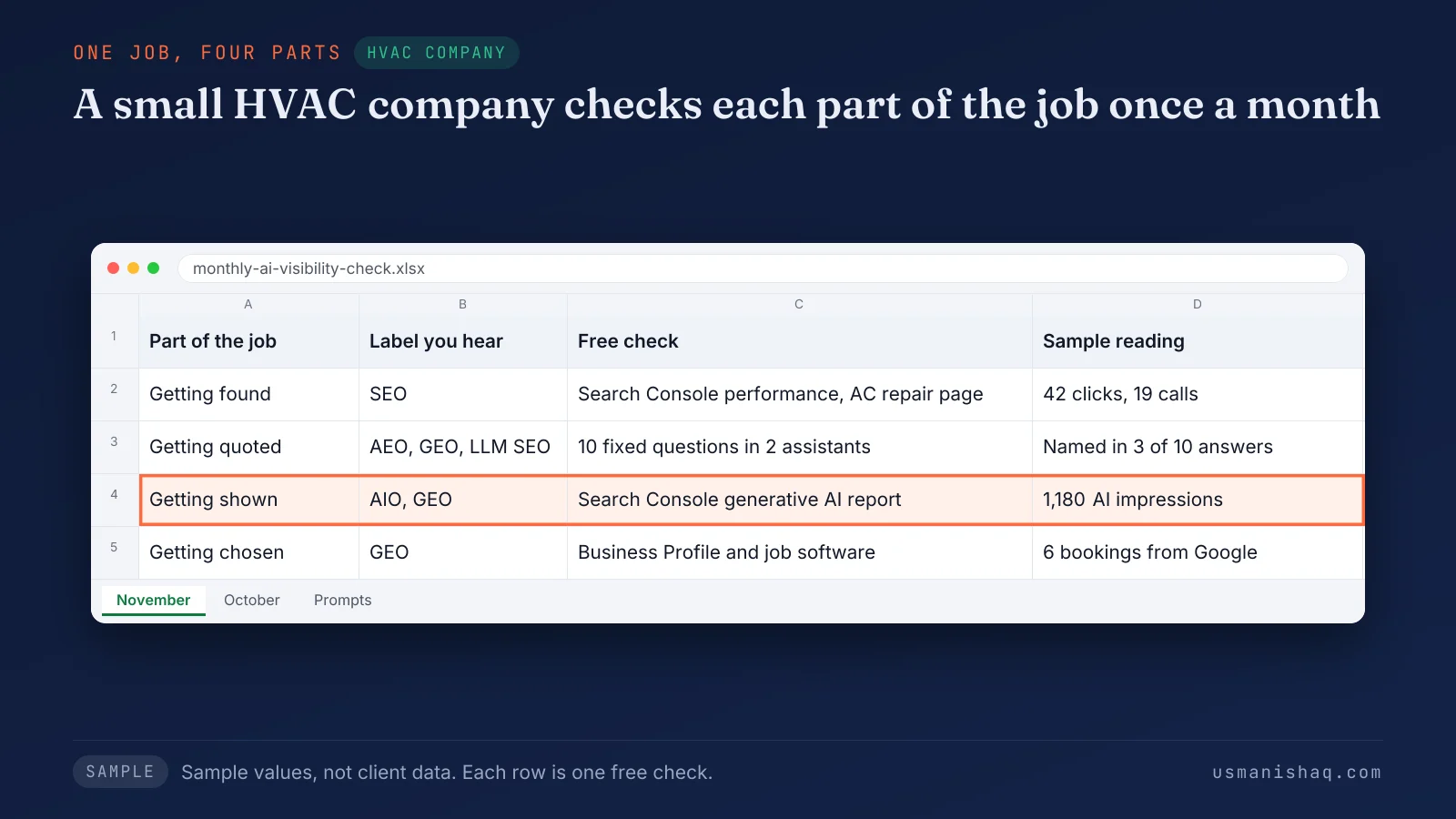
The sample sheet shows a fictional HVAC company with 42 clicks and 19 calls from its AC repair page. Assistants name the company in 3 of 10 test answers. The AC repair page earns 1,180 AI impressions, and the Google listing logs 6 bookings.
The next question is whether a business needs GEO when SEO is already paid for.
Does a small business need GEO if it already does SEO?
No, GEO is not a separate program a small business needs, because Google treats work for its AI features as SEO.
What changes is what the owner checks each month. Mentions sit beside links, quoted answers sit beside clicks, and AI bookings sit beside calls from the site.
Google's Search Central guide on generative AI features, last updated on July 10, 2026, states the position directly. The guide says optimizing for Google's AI answers is optimizing for search, and so still SEO.
The same guide says AI Overviews and AI Mode are rooted in Google's core ranking and quality systems. Grounding is the step where the AI pulls current pages from Google's index before the answer is written. Query fan-out is the step where the AI runs several related searches to cover one question.
Google's guide speaks for Google Search only. ChatGPT and Perplexity run their own retrieval, so the quoted part is checked in each assistant.
An owner who wants to show up in ChatGPT and on Google is asking for one job, not two. Each part of that job still asks the website for something different.
What does each part of the job ask of a small business website?
GEO, AEO, AIO and SEO ask for indexed pages, consistent facts, answer-ready pages and bookable details, and no writing format replaces them.
All four parts read the same pages, so the page plan comes first.
A page plan lists the service, town and question pages a site needs, one page per job the business sells. Semantic SEO Architecture is the work of drawing that plan before any page is written. The page list for the whole site comes from a Semantic SEO Architecture plan, drawn before any GEO or AEO work.
Getting found: what SEO asks of the site
SEO asks a small business for indexed service and town pages that rank, plus a matching Google Business Profile.
Getting found means the business appears in Google results and the map pack for the jobs the business sells. An HVAC company, for example, needs one page for AC repair and another for furnace repair. Each page names the service, the towns served and how the price is set.
Google's guide adds one rule that ties getting found to the other parts. A page must be indexed and eligible for a snippet before Google's AI features can show the page.
The Search Console performance report shows whether getting found works: queries, clicks and the pages that earn them. Calls from the site and the listing complete the reading. No GEO line replaces getting found, because every later part reads the same pages.
Getting quoted: what AEO asks of the site
AEO asks a small business for direct answers on its own pages and the same business facts on other sites.
Getting quoted means ChatGPT, Perplexity, Gemini or another assistant names the business in a written answer. Sellers often price getting quoted as a GEO or AEO line.
Direct answers sit first under each question heading on the site. A plumber's slab leak page opens with the repair method, the detection step and the towns served. Review sites, directories and local news should carry the same name, services and towns as the site.
Mentions on other sites can weigh heavily in AI answers, according to the citation studies Rework summarized in 2026. Google's guide also warns that seeking inauthentic mentions is not a useful shortcut. The same guide favors non-commodity content: first-hand detail that common knowledge does not already cover.
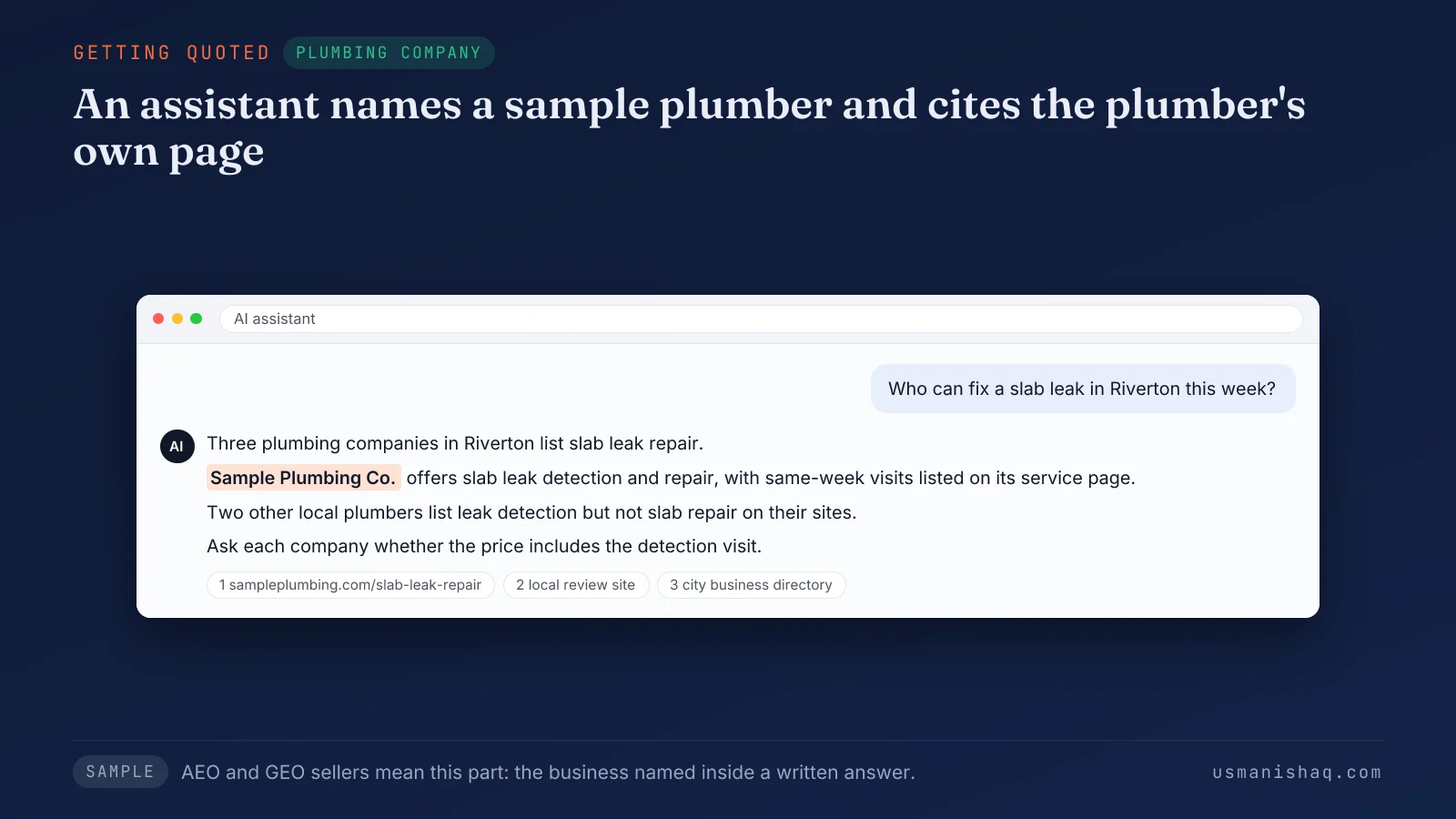
The sample screen shows the assistant naming Sample Plumbing Co. for slab leak repair in Riverton. The answer cites the company's slab leak page, a review site and a city business directory.
The check is simple: ask two assistants the same ten questions each month and note whether the business is named.
Getting shown in AI Overviews and AI Mode: what AIO asks
AIO asks for indexed, snippet-eligible pages, because AI Overviews and AI Mode draw their answers from Google's own index.
Getting shown means a Google AI answer cites a business page as one of its sources. The site must also stay included in the generative AI setting in Search Console. Some sellers sell getting shown under the GEO label too.
Google's guide lists what is not needed: llms.txt files, special markup, chunked content and pages rewritten only for AI.
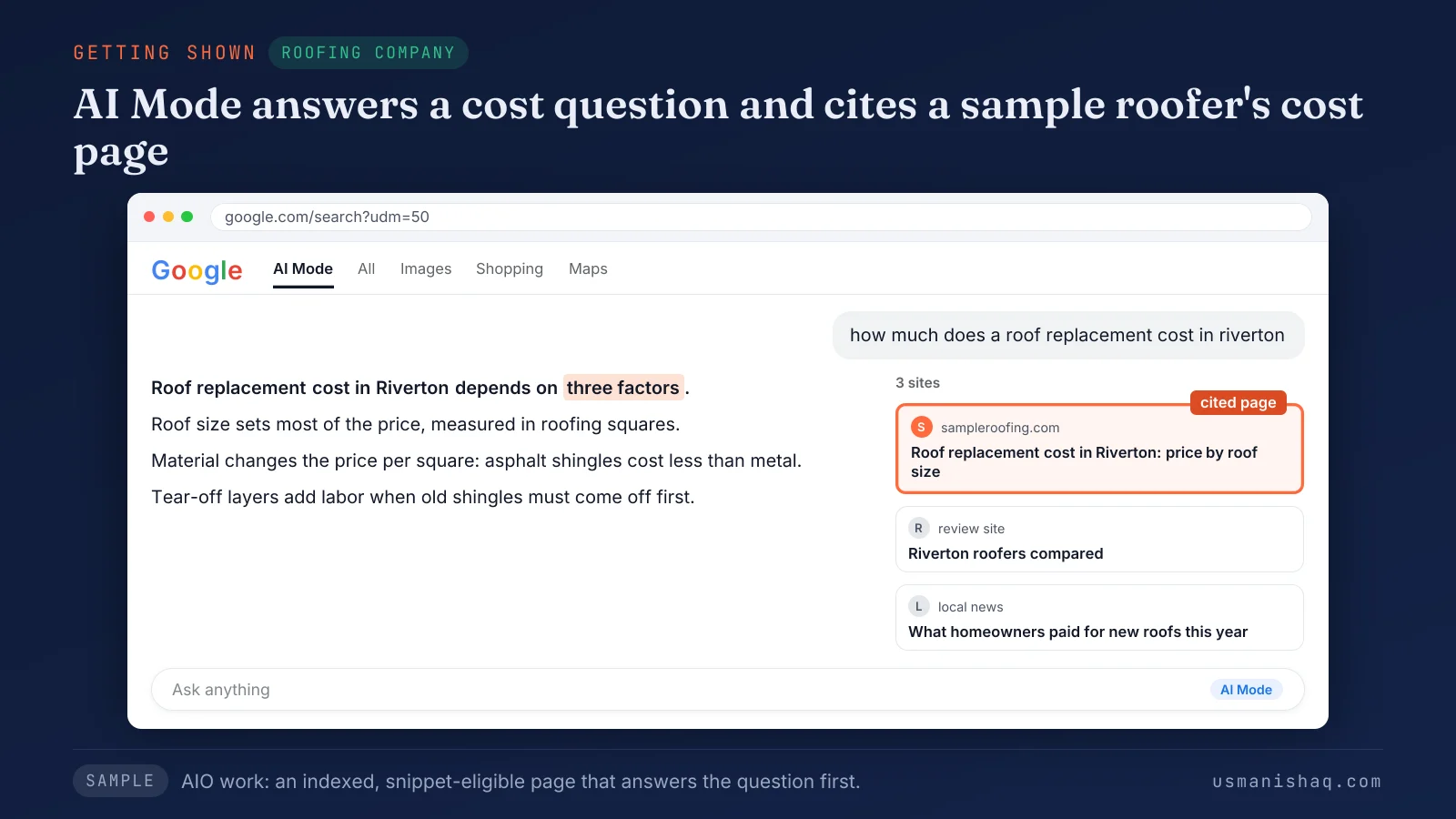
The sample screen shows AI Mode answering a roof replacement cost question with three price factors: roof size, material and tear-off layers. The roofer's cost page is the marked source, beside a review site and a local news page.
Search Console added a generative AI report for all sites on August 31, 2026, according to Search Engine Journal. The report counts impressions and no clicks.
I read that report for my own site page by page, next to the clicks in the performance report. I treat a page with many AI impressions and few clicks as a page being read inside the answer.
Semrush reported a Google logging error that lowered these impressions from November 9 to 11, 2026.
Getting chosen by AI agents: what GEO asks
GEO, in the four-part split, asks a small business for details an AI agent can act on and a working booking path.
Most writers use GEO for getting quoted; the split here also uses GEO for agents, because agents act on the same data. Getting chosen means an AI agent books, calls or buys on the customer's behalf.
Search Engine Roundtable reported on November 5, 2026 that AI Mode added booking and quote buttons for US home services. The bookings run through Angi, Thumbtack, Housecall and Jobber. Google's guide names Google Business Profile details as one source its AI answers can show.
An agent needs services, hours, service area, prices or price ranges, and a booking path that works. The Google Business Profile and the job software hold those facts, so both must match the site.
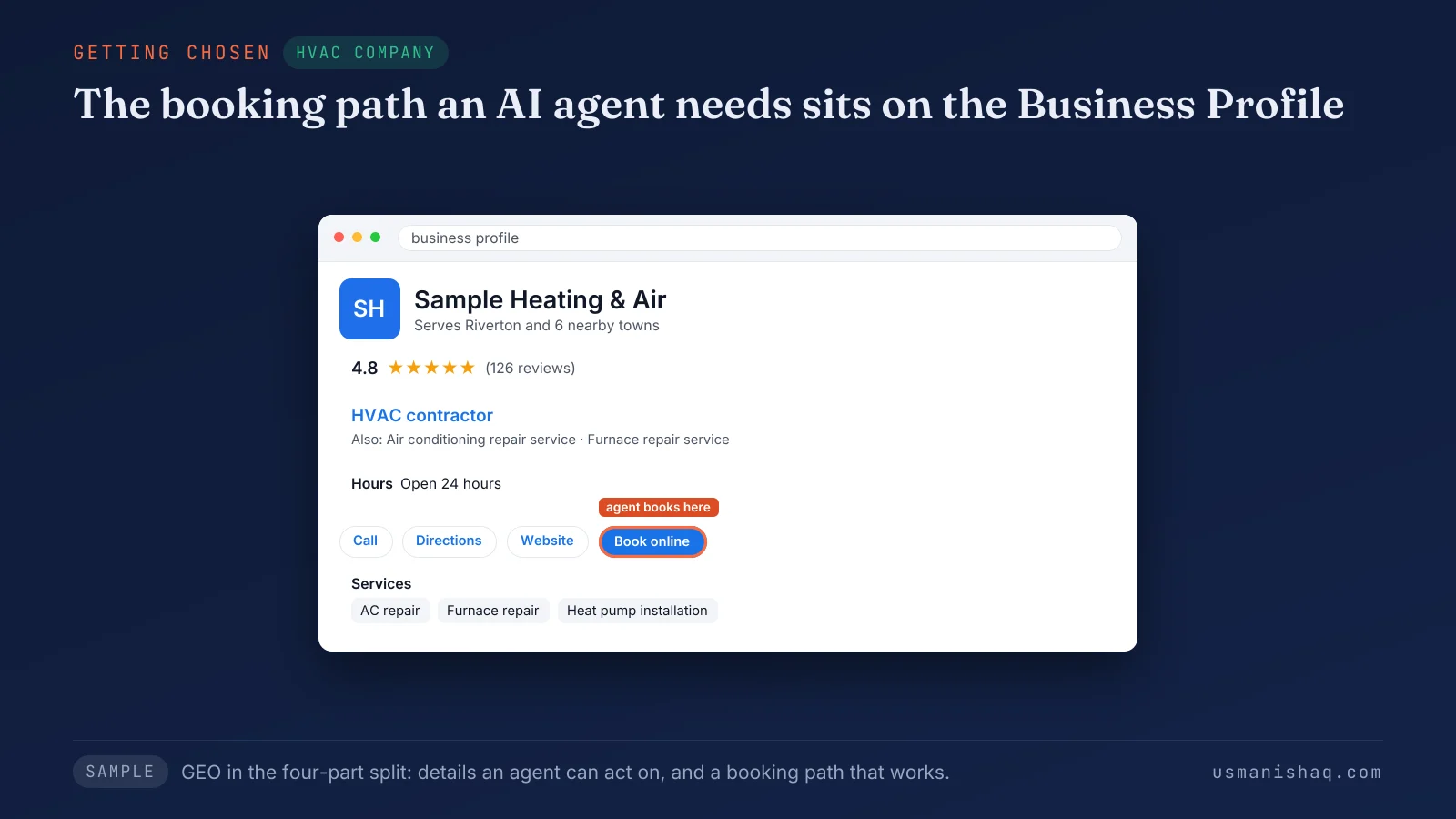
The sample profile lists an HVAC contractor open 24 hours, with AC repair, furnace repair and heat pump installation. The marked Book online button is the booking path an agent needs.
Bookings and calls that start in Google's AI surfaces show in the profile insights and the job software records. Analytics shows AI referrals when a person clicks through from an assistant.
Does a GEO writing format make a page rank or get cited?
No, a GEO writing format does not make a page rank or get cited, because a format changes layout, not the answer.
The GEO writing stack usually looks the same: a question subheading, a two-line answer, a statistic and a link. Google's guide says breaking content into small chunks is not required for its AI features.
The format still has a use: headings and short answers help readers find their way. Google's guide says people value pages organized by clear sections and headings.
Which part should a small business work on first?
GEO work for a small business starts with getting found, then shown, then quoted, then chosen.
Each later part reads the pages and facts the earlier part puts in place. The order of work for a small service business is given below:
- Fix and index the service and town pages, then match the Google Business Profile to them.
- Read the AI impressions for those pages in Search Console, and add answers where clicks stay low.
- Correct the business facts on review sites and directories, so assistants read one version.
- Turn on booking through the job software, and keep hours, prices and service area current.
The first step is the cheapest to fix and the easiest to skip. Semantic SEO is the method behind that order.
Where semantic SEO sits under GEO, AEO and SEO
Semantic SEO sits under GEO, AEO and SEO, because semantic SEO decides which pages exist and what each page means.
A GEO writing format changes how one passage is laid out. Semantic SEO decides the set of pages, the question each page answers and the facts each page states. Facts are written as entity, attribute and value, such as the business, the service area and the town list.
The plan of those pages is the topical map. AI search visibility is the name used here for all four parts together. The four parts are checked and fixed together in an AI Search Visibility service, not as separate GEO and AEO lines.
Agents read the profile and the website, so a mismatch between the two sends mixed facts. The getting chosen part depends on a Google Business Profile and website match that holds month after month.
How to check each part every month without a paid tool
Each part of the job has a free monthly check that an owner can run without a paid tool.
The four checks, in the same order as the parts, are given below:
- Getting found: the Search Console performance report by page for clicks, and call logs for calls.
- Getting quoted: ten fixed questions asked in two assistants, with a yes or no for each answer.
- Getting shown: the Search Console generative AI report by page, beside that page's clicks.
- Getting chosen: Business Profile insights and job software records for bookings and calls.
Write each reading in one sheet with the date, so a change between months shows. None of the four checks needs a GEO tool.
The Google Search Central guide on generative AI features explains the generative AI report and the eligibility rules. An owner who already reads an SEO report each month adds these four lines to that report. The guide on how to read an SEO report shows which lines matter.
What to ask when an agency adds GEO to a quote
An owner should ask which of the four parts a GEO line covers and which free check shows the result.
A small paid test settles the question, and the steps to test an SEO consultant before hiring apply to a GEO line.
Questions owners ask about GEO and AEO
Are GEO tools worth paying for?
Yes, a GEO tool is worth paying for only as a record, because the tool samples AI answers and reports an estimate.
Google's guide says no third-party tool has access to its internal ranking or AI systems.
Does claiming my business in ChatGPT make ChatGPT recommend it?
No, claiming a listing in Businesses in ChatGPT does not buy a recommendation; the claim lets your business correct its listing facts.
OpenAI launched Businesses in ChatGPT as a beta on November 10, 2026. The steps to claim your business in ChatGPT cover the identity check and the listing edits.
GEO, AEO, AIO and SEO as one job
GEO, AEO, AIO and SEO stay one job: clear pages and facts that get a small business found, quoted, shown and chosen.
The work starts with indexed service pages and a matching profile. The labels on a quote matter less than the part each line covers.